By JA Williams Jr. | Boardwalk Standard
For years, critics have predicted Atlantic City’s death. Every casino closing, struggling neighborhood and disappointing financial report has been presented as proof that the resort’s best days were behind it.
The latest numbers tell a different story.
Atlantic City is not dead. It is evolving—and showing measurable signs of resurgence.
More Than One Million Casino-Hotel Room Nights
Atlantic City entered the summer with encouraging tourism results.

During the second quarter of 2026—April through June—the city’s casino hotels recorded an occupancy rate of 73.2%, an increase of 0.6 percentage points from the same period in 2025.
Visitors occupied more than 1.01 million casino-hotel room nights, paying an average rate of $171.71 per occupied room.
Several properties performed particularly well:
– Ocean Casino Resort: 87.1% occupancy
– Hard Rock Hotel & Casino: 86.4%
– Caesars Atlantic City: 82.2%
– Borgata: 76.7%
Those numbers matter because hotel occupancy is a stronger measurement of physical tourism than online gambling revenue. People staying in Atlantic City are also more likely to visit restaurants, attend shows, shop, walk the Boardwalk and patronize other local businesses.
Atlantic City’s casino industry reported $844.5 million in net revenue during Q2, an increase of 0.9% over the same quarter in 2025.
However, gross operating profit declined 10.1% to $164.9 million. The casinos attracted customers and increased revenue, but higher labor, energy, tax, promotional and operating expenses reduced profitability.
That distinction is important: Atlantic City experienced solid visitor demand even while casino operators faced tighter profit margins.
A Strong Summer on the Casino Floors
The traditional June-through-August summer season also produced historically strong in-person casino results.
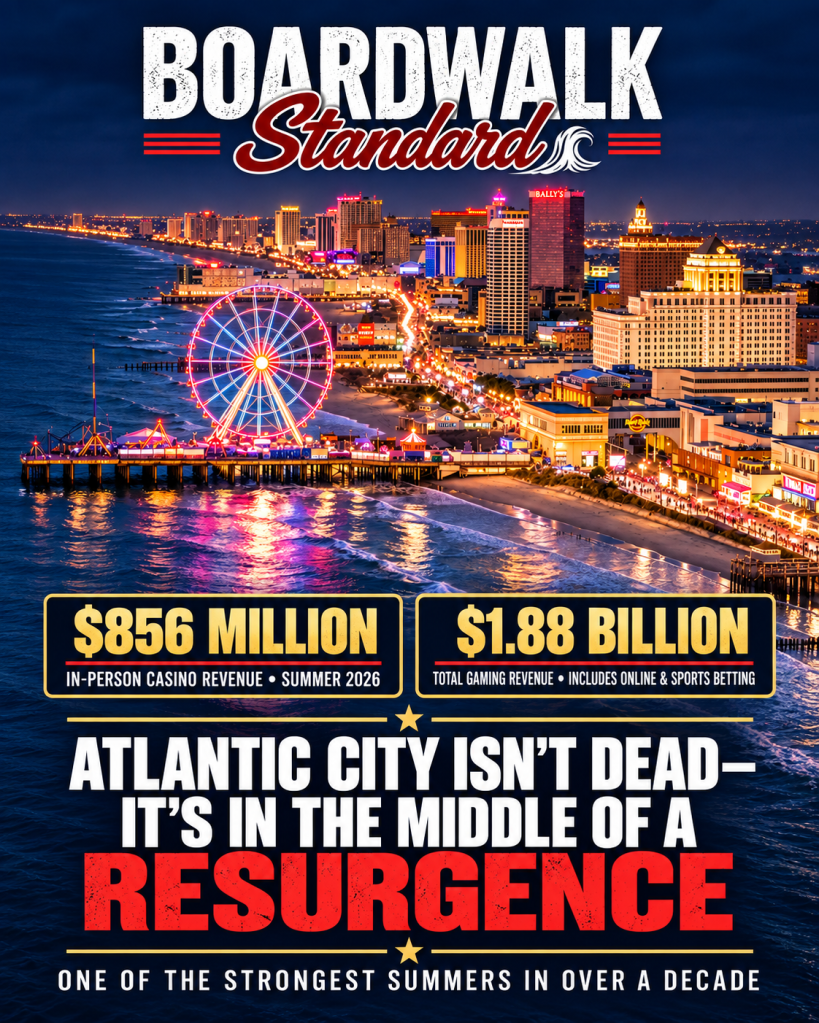
Atlantic City’s nine physical casinos generated approximately $856 million in casino-floor revenue during those three months—one of the strongest summer performances in more than a decade.
July was especially strong, producing approximately $304.2 million in physical casino revenue. August generated $294.9 million. Although August was down from the record-setting performance of August 2025, it still outperformed nine of the previous ten Augusts.
New Jersey’s total gaming revenue for the summer was approximately $1.88 billion, but that figure must be explained accurately. It includes Atlantic City casino revenue, internet gaming and sports wagering connected to casinos, racetracks and online partners.
It is not the same as Atlantic City tourism revenue.
The more meaningful local number is the approximately $856 million generated inside Atlantic City’s physical casinos, combined with rising second-quarter hotel occupancy and more than one million occupied casino-hotel room nights.
Together, those figures demonstrate that visitors are still coming to Atlantic City and spending money.
The Resurgence Extends Beyond Gambling
Atlantic City’s progress cannot be measured exclusively by slot machines and gaming tables.
Casino resorts have invested heavily in renovated hotel rooms, new restaurants, entertainment venues and upgraded gaming spaces. The city continues attracting concerts, sporting events, conventions, festivals and other activities that bring visitors to the resort.
Stockton University’s Atlantic City campus has also introduced students, employees and institutional investment into an area that once struggled to attract substantial development beyond the casino district.
The city is gradually becoming more than a collection of gambling halls.
That does not mean Atlantic City has solved all its problems.
Too many residents still live in poverty. Neighborhood development remains uneven. Public safety and cleanliness continue to influence the city’s reputation. Businesses located outside the casino properties do not always receive an equal share of tourism spending.
Internet gambling also creates a complicated financial picture. Online revenue may be connected to Atlantic City casino licenses, but much of that money is generated remotely and shared with outside technology companies. It does not necessarily create the hotel stays, restaurant purchases and local employment produced by physical visitors.
That is why casino-hotel occupancy and in-person spending remain essential measurements.
The Entire City Must Benefit
Atlantic City’s next challenge is ensuring that the resurgence reaches beyond the casino walls.
Growth should create opportunities for independent restaurants, retailers, contractors, artists and minority-owned businesses. Visitors should be encouraged to explore Tennessee Avenue, Gardner’s Basin, the Orange Loop, Ducktown and other neighborhoods beyond the major resorts.
Atlantic City must also continue improving the Boardwalk, public safety, cleanliness, transportation and overall visitor experience.
A strong spring and summer are encouraging, but long-term success will depend on making Atlantic City attractive throughout the year.
The old Atlantic City may never return—and that may be a good thing.
The future cannot depend entirely on busloads of gamblers arriving for a few hours and leaving. The new Atlantic City must combine gaming with entertainment, dining, conventions, education, sports, beaches, culture and neighborhood businesses.
The numbers do not support the claim that Atlantic City is dead.
They show a city that has survived casino closures, recessions, competition from surrounding states and a global pandemic—and is still attracting visitors, filling hotel rooms and generating substantial economic activity.
Atlantic City is not finished.
It is rebuilding, reinvesting and redefining itself. The resurgence is real, but the next step is ensuring that the entire city—and not only the casino properties—benefits from the comeback.
Sources: “New Jersey Division of Gaming Enforcement Q2 2026 Operational Performance Report”
(https://www.nj.gov/oag/ge/docs/Financials/QuarterlyFinRpt2026/2ndQTR2026PressRelease.pdf); New Jersey Division of Gaming Enforcement monthly gaming reports.
 Uptown Standard