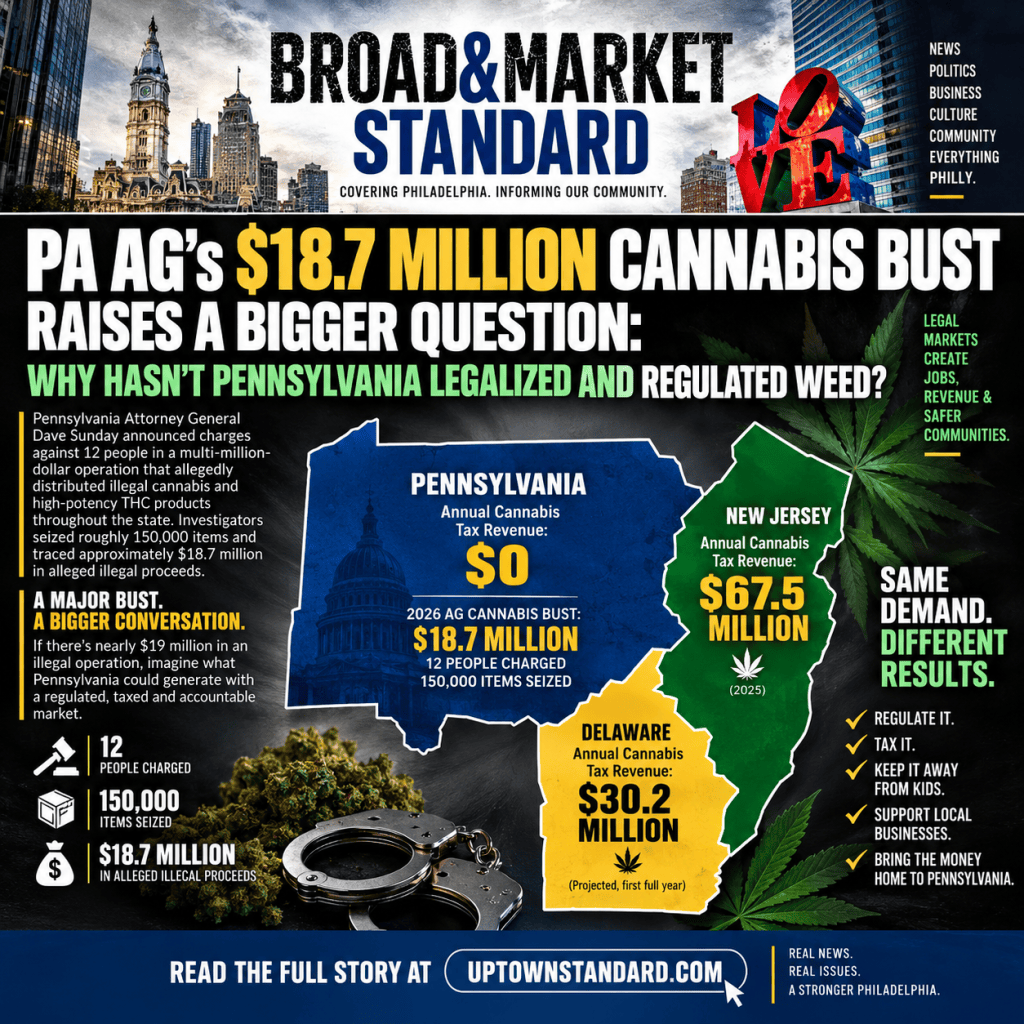
Pennsylvania Attorney General Dave Sunday just announced the takedown of what authorities describe as a massive illegal cannabis and high-potency THC distribution operation.
Twelve people have been charged. Investigators say approximately 150,000 items were seized from three distribution warehouses in Bensalem, Pittston and Plum Borough, while approximately $18.7 million was traced to alleged illegal proceeds. The defendants are presumed innocent unless and until proven guilty.
The Attorney General’s Office says products moved from warehouses into convenience stores and smoke shops throughout Pennsylvania. Authorities allege some products were packaged and flavored in ways attractive to children—exactly the type of problem that demands serious enforcement.
But the sheer size of the alleged operation raises another question Pennsylvania can no longer avoid:
Why does the Commonwealth continue allowing such a large cannabis market to operate in the shadows instead of creating a tightly regulated adult-use marketplace?
That does not mean Pennsylvania should tolerate unlicensed THC products, sales to children or businesses operating outside the law. Quite the opposite.
Legalization should come with regulation.
Require licensed sellers. Test products. Control packaging. Establish age restrictions. Track cannabis from production through retail. Tax legal sales. Shut down businesses that operate outside that system.
Pennsylvania already has cannabis demand. The question is whether that demand will continue supporting an underground and gray market—or move into a regulated marketplace.
Meanwhile, neighboring New Jersey and Delaware have already chosen regulation and taxation.
Pennsylvania consumers can cross state lines and participate in legal adult-use markets while Pennsylvania forgoes the corresponding legal business activity and tax revenue at home.
The Attorney General’s bust should therefore be viewed as more than a criminal case.
It should restart a larger public-policy conversation.
If an alleged illegal cannabis operation can generate nearly $19 million while Pennsylvania prohibits recreational sales, imagine the scale of the market the Commonwealth could bring under licensing, testing, taxation and enforcement.
Pennsylvania doesn’t have to choose between legalization and law enforcement.
It can do both.
Legalize cannabis for adults. Regulate it aggressively. Keep it away from children. Prosecute unlicensed trafficking. Give legitimate Pennsylvania businesses a pathway into the market.
And instead of watching neighboring states participate in a legal cannabis economy, Pennsylvania can decide how that economy operates within its own borders.
 Uptown Standard