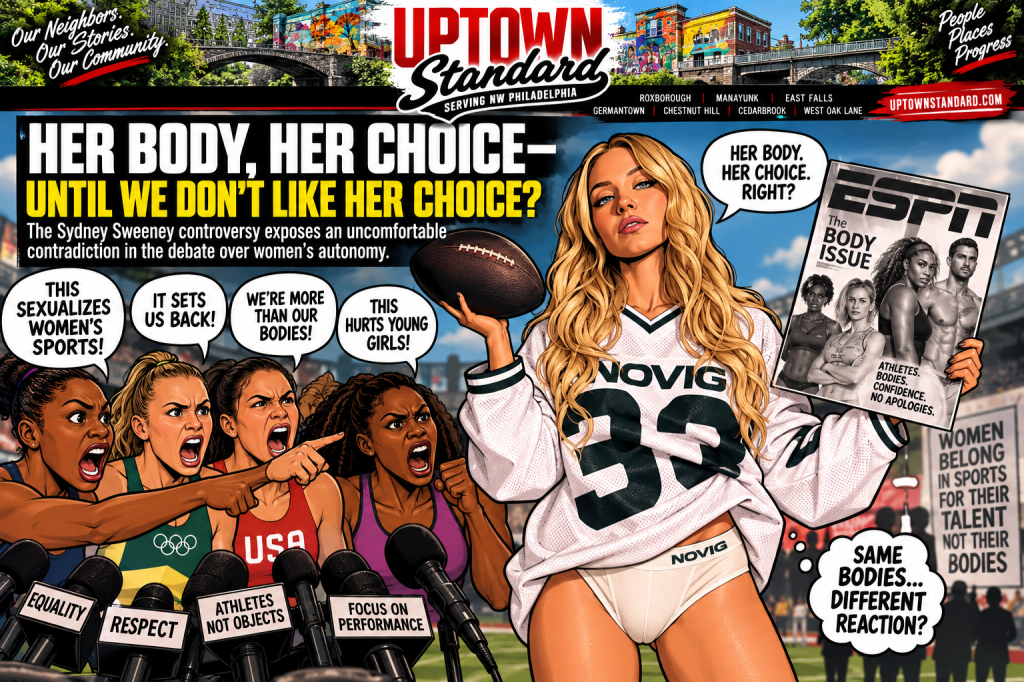
The Sydney Sweeney controversy exposes an uncomfortable contradiction in the debate over women’s autonomy.
By James Williams
Sydney Sweeney is once again at the center of a cultural controversy.
This time, the debate isn’t about her acting, her politics or even something she said. It’s about what she chose to do with her own body.
Sweeney recently appeared in a provocative advertising campaign for sports prediction platform Novig. In the commercial, she appears nude, strategically covered by footballs, basketballs and other sports equipment.
The reaction was immediate.
Female athletes, including Olympic swimming champion Ariarne Titmus, British sprinter Amy Hunt and former American gymnast Gracie Kramer, criticized the campaign, arguing that it sexualizes women in sports and undermines the struggle of female athletes to be recognized for their talent, strength and accomplishments rather than their bodies.
Their concerns deserve to be heard.
But so does an uncomfortable question:
Her body, her choice—right?
WHEN AUTONOMY BECOMES COMPLICATED
For decades, women’s autonomy has been a central principle in American debates over gender and equality.
Women should control their bodies.
Women should determine how they dress.
Women should determine how they express their sexuality.
Women shouldn’t need society’s permission to make those decisions.
That principle sounds relatively straightforward until a woman makes a choice other women strongly dislike.
Sydney Sweeney presents exactly that test.
This wasn’t simply an actress showing up for a commercial and doing whatever an advertising executive instructed her to do.
According to Novig CEO Jacob Fortinsky, Sweeney is an equity holder in the company, approached Novig about a partnership and played a significant role in developing the campaign.
Fortinsky said Sweeney was driving much of its “visuals and messaging.”
That distinction matters.
Sweeney wasn’t merely the product.
She was participating in the business.
She apparently made a calculated decision to use one of her greatest commercial assets—her celebrity and sex appeal—to generate attention for a company in which she has a financial interest.
And it worked.
Front Office Sports reported that the advertisement accumulated tens of millions of views on social media, dramatically outperforming Novig’s previous content.
You don’t have to like that decision.
But acknowledging a woman’s autonomy means acknowledging that sometimes she will exercise it differently than you would.
SEXUALIZATION OR SELF-DETERMINATION?
The strongest argument from Sweeney’s critics isn’t that she shouldn’t be allowed to pose nude.
It’s about consequences.
Female athletes have spent generations fighting against the idea that their value in sports should depend upon their attractiveness.
They want young girls watching sports to see strength, discipline, competition and achievement—not another woman’s body being used to attract male attention.
That’s a legitimate concern.
But another principle exists alongside it:
Sydney Sweeney isn’t responsible for representing every woman.
She isn’t an Olympic swimmer.
She isn’t a professional basketball player.
She isn’t claiming that female athletes should market themselves sexually.
She’s an actress and businesswoman making a decision about how she wants to present herself.
That’s where the debate becomes considerably more complicated.
If bodily autonomy means anything, shouldn’t it include decisions other women disagree with?
Otherwise, “her body, her choice” risks becoming:
Her body. Her choice. As long as we approve of the choice.
WHO GETS TO DECIDE WHAT EMPOWERMENT LOOKS LIKE?
There is another uncomfortable aspect of this debate.
Women have historically faced enormous social pressure concerning how much sexuality is considered acceptable.
Dress too conservatively and you’re prudish.
Show too much and you’re objectifying yourself.
Embrace sexuality and you’re supposedly setting women backward.
Reject it and someone else may accuse society of policing women’s bodies.
There is seemingly always someone prepared to establish the acceptable boundary.
That raises a fundamental question:
Who gets to decide when a woman’s sexuality is empowering and when it becomes exploitation?
If Sydney Sweeney were being coerced, manipulated or unknowingly exploited, that would be an entirely different discussion.
But the available reporting describes something substantially different: an adult woman with an ownership interest participating creatively in a campaign designed to capitalize on her own celebrity.
That doesn’t automatically make the advertisement good.
It doesn’t mean female athletes shouldn’t criticize it.
And it certainly doesn’t mean everyone needs to celebrate it.
Freedom of choice also means freedom to criticize someone else’s choice.
But criticism should not erase agency.
THE ESPN QUESTION
Sweeney seemingly responded to the controversy indirectly by sharing images from ESPN’s famous Body Issue, which featured male and female athletes posing nude or semi-nude.
That comparison isn’t perfect.
ESPN’s project generally presented the athletic body itself as something to celebrate. Novig’s advertisement unmistakably uses Sweeney’s sex appeal as a marketing device.
Those are different contexts.
But Sweeney’s response still raises an interesting question.
If athletes can voluntarily display their bodies and have that decision characterized as confidence or empowerment, why must another adult woman’s voluntary decision to display hers automatically represent exploitation?
Perhaps the answer is context.
Perhaps intention matters.
Perhaps commercial purpose matters.
But those distinctions should be articulated rather than assumed.
AUTONOMY DOESN’T REQUIRE APPROVAL
And that’s ultimately what makes this controversy bigger than Sydney Sweeney.
We frequently defend individual freedom in the abstract.
The real test comes when someone uses that freedom in a way we dislike.
Female athletes have every right to say the Novig advertisement contributes to a culture they’ve spent their careers fighting against.
Sydney Sweeney has an equally legitimate claim to agency over her own image.
Those two ideas can coexist.
We can debate whether the advertisement is tasteful.
We can debate whether it’s good for women’s sports.
We can debate whether using sexuality to sell a sports product reinforces outdated stereotypes.
But perhaps we should be careful about turning a disagreement with a woman’s decision into a denial of her ability to make it.
Because bodily autonomy was never supposed to mean:
Her body, our choice.
It means something considerably more difficult:
Her body. Her choice.
Even when we don’t like the choice.
 Uptown Standard