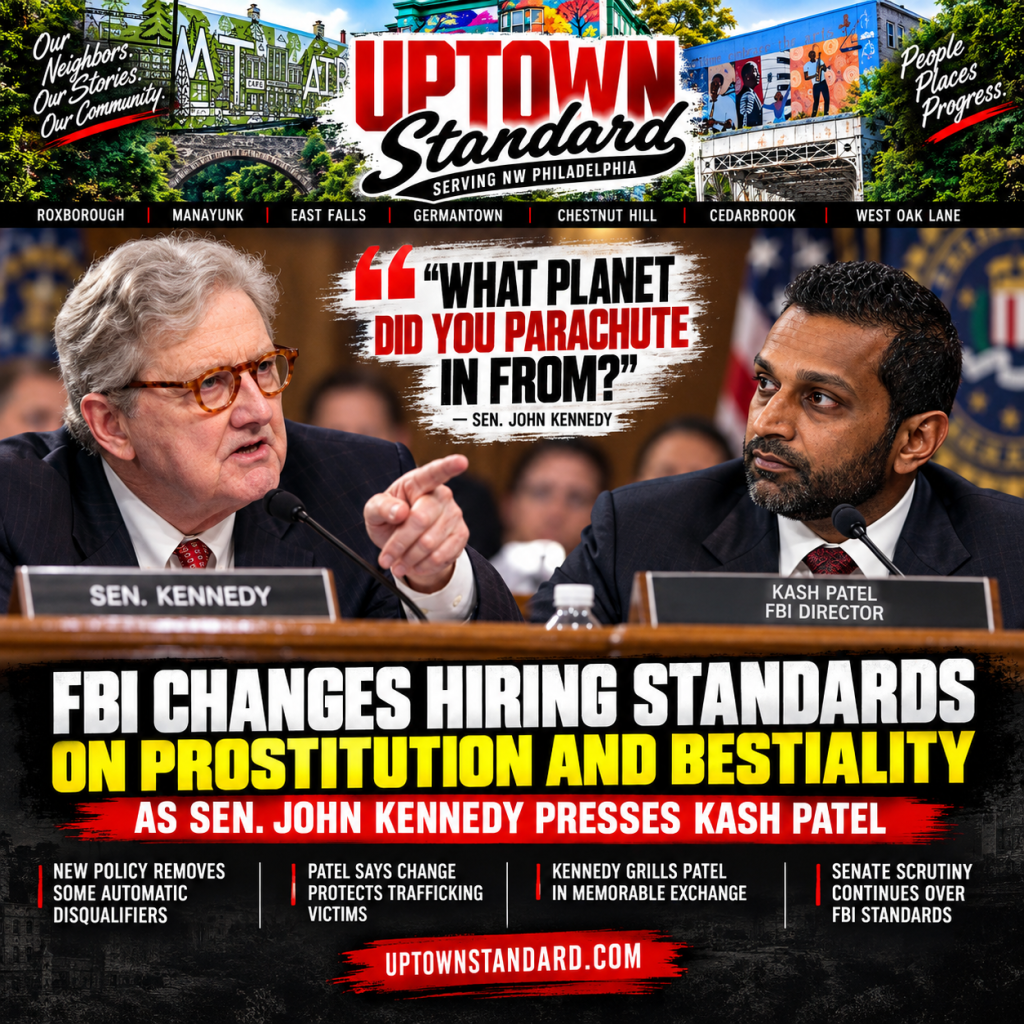
The FBI has revised controversial hiring standards involving prostitution and bestiality, prompting congressional scrutiny and a memorable exchange between FBI Director Kash Patel and Louisiana Sen. John Kennedy during a Senate Judiciary Committee hearing.
The policy changes do not mean the FBI has declared such conduct acceptable. Instead, certain circumstances that previously could result in automatic disqualification may now receive individualized consideration.
The distinction became a central issue during Kennedy’s questioning of Patel.
What Changed at the FBI?
The FBI revised several standards governing when an applicant’s past conduct automatically prevents that person from being considered for employment.
One change involves prostitution. Under the revised standards, some past involvement no longer necessarily results in automatic lifetime rejection. However, the FBI retains restrictions involving more recent or repeated conduct and other circumstances.
Another—and considerably more controversial—change involves bestiality.
Reported changes to FBI hiring criteria mean certain conduct occurring before an applicant turned 18 is no longer necessarily treated as an automatic disqualifier.
That immediately raised a basic question on Capitol Hill:
Why would the FBI change a hiring standard involving conduct this serious?
Patel told senators that the answer involves circumstances that may be very different from what the headline initially suggests.
According to Patel, one purpose of the changes is to prevent victims of human trafficking, sexual exploitation, abuse or coercion from being automatically rejected because of conduct they were forced to participate in.
That explanation became the focus of Kennedy’s questioning.
Kennedy Wants a Straight Answer
Kennedy is known for using blunt language and straightforward hypotheticals during congressional hearings, and his questioning of Patel followed that pattern.
Kennedy wanted to know exactly what had changed—and why.
When Patel described the previous bestiality standard as potentially disqualifying someone who participated “on either side,” Kennedy responded with one of the hearing’s more unusual questions:
“So, you disqualified the animal?”
Patel responded with a reference to the FBI’s canines, but Kennedy quickly returned to the substance of the issue.
He wanted to understand why FBI leadership would get involved with changing a hiring standard concerning bestiality in the first place.
Kennedy eventually asked Patel why, when presented with such a proposal, he didn’t essentially respond:
“What planet did you parachute in from?”
Patel acknowledged that his initial reaction was similar.
But Patel said FBI officials subsequently presented circumstances involving people who had been trafficked or abused and forced to participate in sexual acts.
Under an absolute disqualification policy, someone victimized as a child could potentially be prevented from consideration for FBI employment years later because of something that person was forced to do.
Patel said those circumstances warranted consideration rather than an automatic rejection.
Kennedy Draws the Critical Distinction
Kennedy then reduced the controversy to a straightforward hypothetical.
What happens if someone voluntarily engages in bestiality?
Should that person be eligible to become an FBI agent?
Patel told Kennedy:
“If he voluntarily did it, sure. But if he was trafficked into it, then he should be considered.”
In context, Patel was answering whether voluntary participation should result in disqualification.
Kennedy pressed further.
Could someone who voluntarily had sex with an animal become an FBI agent?
Patel said no.
Kennedy asked:
“They can’t be, can they?”
Patel responded:
“They cannot.”
That exchange provided an important clarification to some of the headlines surrounding the FBI’s policy change.
According to Patel’s testimony, the FBI is not attempting to make voluntary bestiality acceptable conduct for prospective FBI employees.
His stated rationale is that someone who was trafficked, abused or coerced should not necessarily receive the same automatic employment disqualification as someone who voluntarily committed the conduct.
Prostitution Raises a Similar Question
The prostitution provision presents another distinction.
There is a significant difference between an applicant who voluntarily purchased sexual services and someone who was forced into prostitution as a victim of human trafficking.
The revised FBI standards reportedly provide more discretion in evaluating certain past conduct instead of imposing an automatic lifetime prohibition in every circumstance.
That doesn’t mean every applicant with such a history gets hired.
Removing an automatic disqualifier and approving someone for FBI employment are two different things.
Applicants still undergo extensive background investigations and suitability and security evaluations. The policy change concerns whether certain conduct immediately ends consideration before the surrounding circumstances can be examined.
But Does the Written Policy Match Patel’s Explanation?
That’s where the controversy becomes more substantive.
Other members of the Senate Judiciary Committee questioned whether the actual language of the FBI standards draws the trafficking-victim distinction as narrowly and explicitly as Patel described it during his testimony.
Sen. Dick Durbin, the committee’s ranking Democrat, challenged Patel over the wording concerning applicants who had engaged in bestiality.
Patel maintained that the policy change was intended to address victims who had been forced into such conduct.
That creates an important congressional oversight question:
If protecting trafficking and abuse victims is the objective, does the written FBI policy explicitly limit its exceptions to those circumstances?
Or does the revised language provide FBI officials with broader discretion?
Those are different questions from whether victims of trafficking deserve consideration.
Kennedy’s Humor Exposed the Bigger Policy Question
Kennedy’s comments are likely to generate the most attention online.
“So, you disqualified the animal?”
And:
“What planet did you parachute in from?”
They are classic examples of Kennedy’s hearing style.
But underneath the humor was a legitimate oversight question:
Exactly who can now qualify for FBI employment who previously would have been automatically disqualified?
Patel gave senators one important answer.
Someone who was trafficked, abused or coerced should not necessarily be permanently barred from consideration because of something that person was forced to participate in.
Someone who voluntarily engaged in bestiality, Patel told Kennedy, cannot become an FBI agent.
The Policy, Not the Sound Bite, Is the Bigger Story
The unusual subject matter makes this an easy story to sensationalize.
But the actual policy debate is more complicated.
Congress is examining how the FBI balances two competing considerations: maintaining stringent standards for people entrusted with federal law-enforcement authority while ensuring that victims of trafficking and abuse aren’t punished for conduct imposed upon them.
Kennedy’s questioning forced Patel to publicly explain where he believes that line should be drawn.
Victims can receive consideration. Voluntary conduct can still result in disqualification.
The next issue for congressional oversight is whether the FBI’s written hiring standards establish that distinction as clearly as its director did before the Senate.
And that—not simply the provocative words “prostitution” and “bestiality”—is the central question surrounding the FBI’s new hiring policy.
 Uptown Standard