By JA Williams Jr
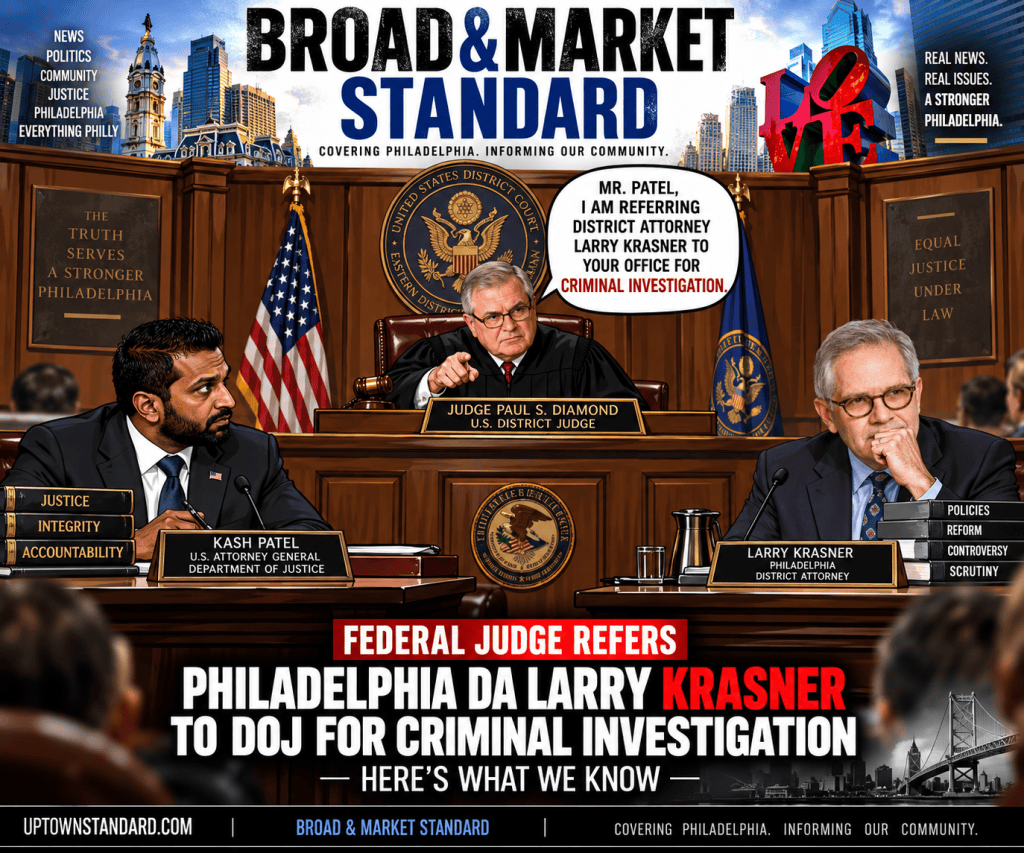
Philadelphia District Attorney Larry Krasner is facing a significant new legal development after U.S. District Judge Paul S. Diamond referred Krasner and members of his office to federal prosecutors for possible criminal investigation.
The referral immediately carries political implications because Krasner is one of the country’s most prominent progressive district attorneys. But the circumstances surrounding the case are important: this did not originate as a campaign investigation or legislative attack on Krasner. It emerged from proceedings in federal court and testimony concerning the conduct of his office.
What Happened?
Judge Diamond referred Krasner, the Philadelphia District Attorney’s Office, and senior Assistant District Attorney Matthew Stiegler to the U.S. Attorney’s Office for the Eastern District of Pennsylvania.
Diamond wrote that conduct revealed during the proceedings could potentially implicate federal crimes including perjury, conspiracy and obstruction of justice.
That language is serious.
But an equally important point must be made: a judicial referral is not a criminal charge, indictment or finding of guilt.
Federal prosecutors will determine what action, if any, should follow.
Where Did This Come From?
The controversy stems from federal proceedings involving Dennis Johnson, who was convicted of second-degree murder in 2009 and is seeking to overturn his conviction.
During litigation surrounding Johnson’s case, questions developed over how the Philadelphia District Attorney’s Office handled the matter and whether conflicts existed within the office.

The particularly significant aspect of the controversy is that some of the evidence cited by Diamond came from prosecutors within Krasner’s own office.
Testimony described disagreements over whether the case should have been transferred to the Pennsylvania Attorney General’s Office and included allegations concerning pressure placed on employees and representations made to the federal court.
Those allegations remain allegations unless established through the appropriate criminal process.
Who Is Judge Paul Diamond?
Diamond is a federal judge on the U.S. District Court for the Eastern District of Pennsylvania.
He was appointed to the federal bench in 2004 by Republican President George W. Bush.
That fact will inevitably become part of Philadelphia’s political conversation because Krasner is a Democrat and nationally identified with progressive criminal-justice reform.
But a judge’s appointing president, standing alone, does not establish political motivation.
Diamond’s referral arose from testimony and evidence presented during judicial proceedings. Whether his conclusions are ultimately upheld—and whether federal prosecutors believe any criminal investigation or prosecution is warranted—are separate questions.
Krasner has publicly rejected Diamond’s conclusions, saying that he “respectfully and vigorously” disagrees with the judge’s findings and intends to pursue available appellate remedies.
Is This Political?
That is where Philadelphia should be careful.
There is unquestionably a political backdrop.
Krasner has been one of Pennsylvania’s most polarizing elected officials. Republicans in Harrisburg previously attempted to impeach him, while supporters have characterized many attacks against him as opposition to his progressive approach to prosecution and criminal-justice reform.
But political context and political motivation are not the same thing.
The current federal controversy arose from a court proceeding involving a criminal conviction and testimony concerning the internal actions of the District Attorney’s Office.
The evidence should therefore be evaluated on its merits rather than automatically dismissed as politics—or automatically treated as proof that Krasner committed a crime.
What Happens Next?
The referral now places the issue before federal prosecutors.
The U.S. Attorney’s Office can review the judge’s findings and underlying record and determine whether additional investigation is warranted. An investigation could end without charges, or prosecutors could determine that further legal action is justified.
For Krasner, that distinction matters.
He has not been convicted of anything as a result of Diamond’s referral. He has not been indicted based on it. And the referral itself does not establish criminal liability.
At the same time, a federal judge referring the sitting Philadelphia District Attorney and members of his office for possible investigation involving allegations as serious as obstruction or perjury is not a routine political disagreement.
Philadelphia should watch what happens next.
The central question is no longer simply whether people support or oppose Larry Krasner’s politics.
It is whether federal prosecutors examining the underlying evidence conclude that a criminal investigation is warranted—and, ultimately, whether the evidence supports any criminal charges.
Until that process unfolds, both conclusions—“Krasner is guilty” and “this is simply political”—go beyond what has currently been established.
— Uptown Standard | Philadelphia News & Analysis
 Uptown Standard