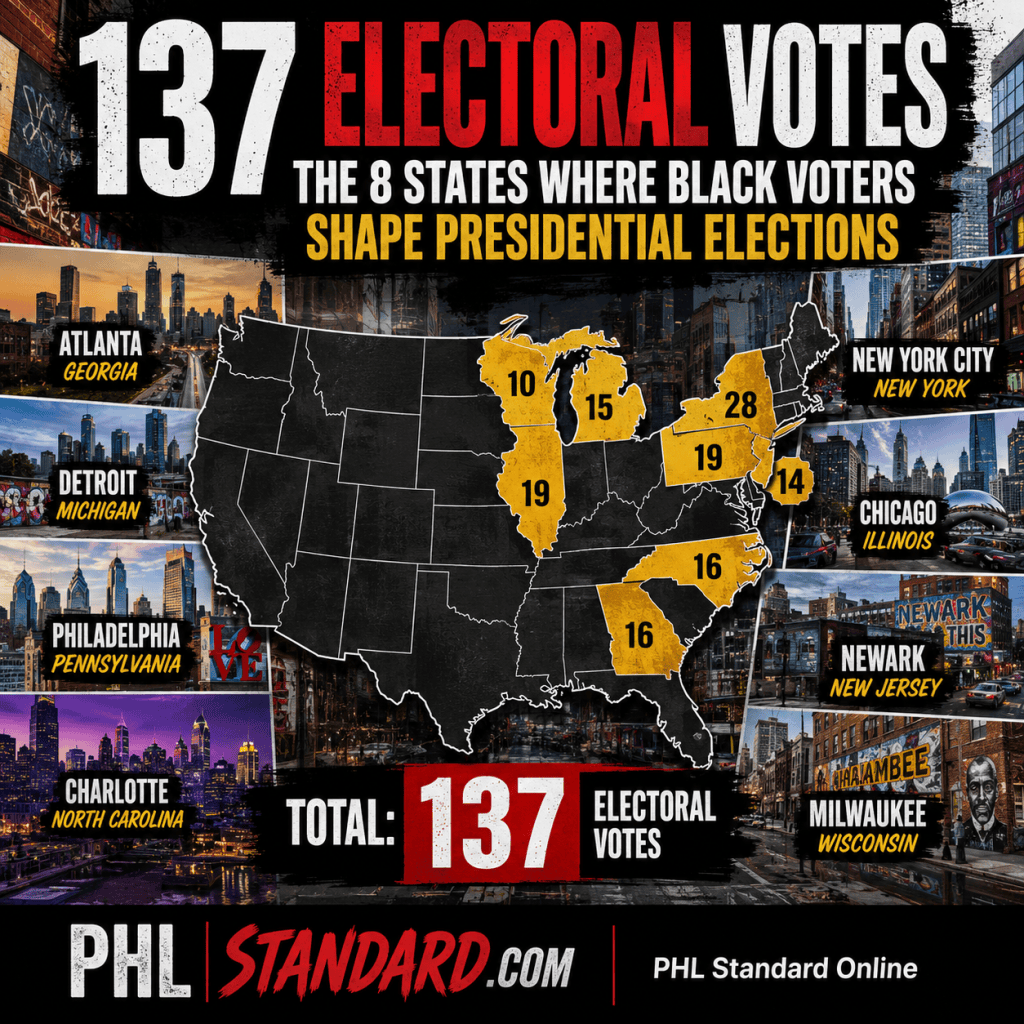
When political analysts discuss the Black vote, the conversation often centers on swing states such as Georgia, Pennsylvania, and Michigan. While these states are critically important, that perspective overlooks the broader reality: Black voters influence presidential outcomes far beyond traditional battlegrounds.
Consider the following states:
– Georgia — 16 Electoral Votes
– Michigan — 15 Electoral Votes
– Pennsylvania — 19 Electoral Votes
– North Carolina — 16 Electoral Votes
– Wisconsin — 10 Electoral Votes
– New York — 28 Electoral Votes
– Illinois — 19 Electoral Votes
– New Jersey — 14 Electoral Votes
Together, these states represent 137 Electoral College votes—more than half of the 270 electoral votes needed to win the presidency.
The influence of Black voters extends from Atlanta and Detroit to Philadelphia, Chicago, New York City, Newark, Camden, and Milwaukee. In some states, Black voters help determine which candidate wins a closely contested election. In others, they provide the margin that secures a state’s electoral votes for one party or another.
Too often, political discussions focus only on whether Black voters can “flip” a state. A more accurate question is: How much does the Black electorate contribute to building and sustaining winning coalitions? The answer is significant.
In New York, Illinois, and New Jersey, Black voters are not merely participants in the political process—they are a foundational part of the electoral coalition that delivers those states’ electoral votes. In Georgia, Pennsylvania, Michigan, North Carolina, and Wisconsin, Black voter turnout can directly affect statewide outcomes and, by extension, the presidency itself.
The Electoral College is won state by state, and across these eight states, Black communities remain one of the most influential voting blocs in American politics. Whether in a swing state or a reliably partisan state, the Black vote continues to shape the national political landscape and the path to 270 electoral votes.
This is not to suggest that Black voters alone determine election outcomes. Presidential elections are decided by broad coalitions that include voters of many backgrounds. However, in these eight states, Black voters are a critical part of those coalitions and, in many cases, provide the margins that make statewide victories possible.
As America looks toward future elections, candidates seeking the White House would be wise to recognize a simple reality: the road to victory still runs through many of the nation’s largest and most politically engaged Black communities. Understanding where those communities are located—and the Electoral College votes attached to those states—is essential to understanding modern presidential politics.
 Uptown Standard