By Staff
A bill passed by the New York State Legislature is generating debate across the political spectrum, reigniting a broader national conversation about family, identity, and the role of government in defining both.
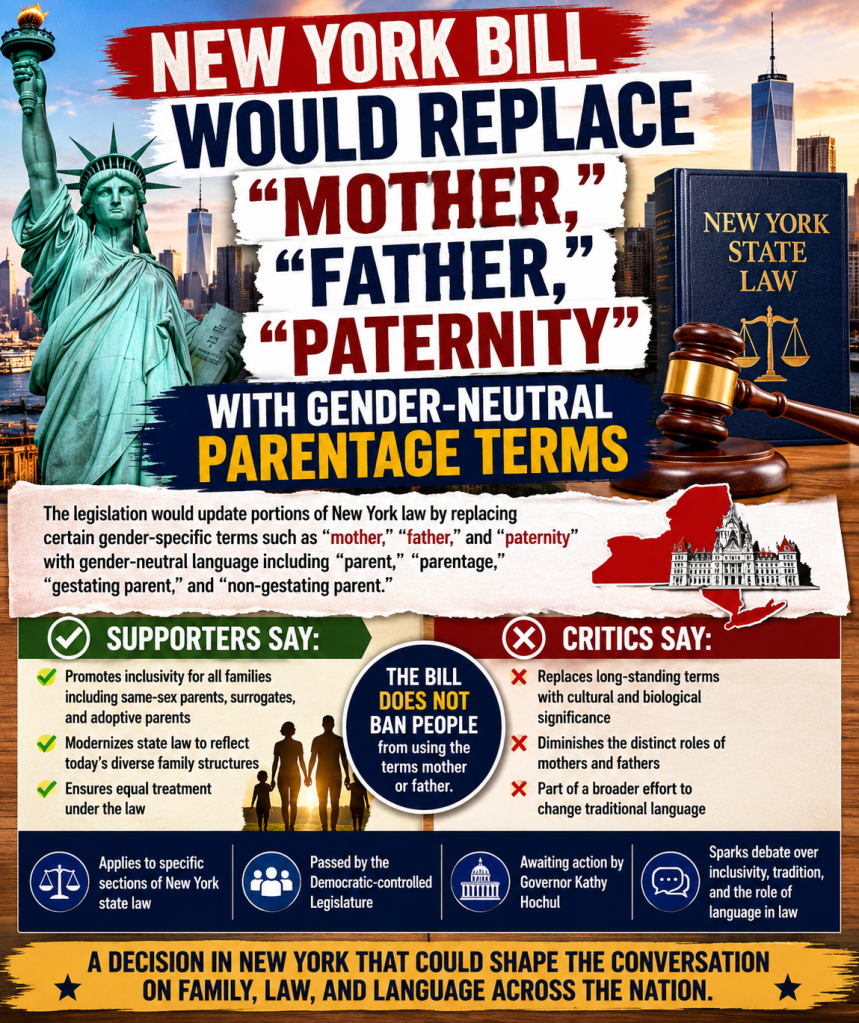
The legislation would update portions of New York state law by replacing certain gender-specific terms — including “mother,” “father,” and “paternity” — with gender-neutral alternatives such as “parent,” “parentage,” “gestating parent,” and “non-gestating parent.” The bill has cleared both chambers of the legislature and now awaits action by Governor Kathy Hochul.
The proposed changes are limited in scope. They apply specifically to legal terminology within New York’s statutes — the formal language used in courts, government documents, and official proceedings. The bill does not regulate how individuals refer to themselves or their family members in everyday life. A person would remain free to identify as a mother or father, and nothing in the legislation would change that.
Proponents say the update is largely a technical one, bringing legal language in line with the realities of how families are formed today. Courts and legal professionals already navigate complex parentage questions involving adoptive parents, same-sex couples, and families created through surrogacy or assisted reproduction. Supporters argue that gender-neutral terminology provides a clearer, more consistent legal framework for all of these situations, pointing to cases where outdated terminology has complicated custody determinations, adoption proceedings, and parental rights.
Critics, however, argue that terms like “mother” and “father” are not merely legal constructs — they carry biological, cultural, and historical significance that should not be legislated away. For many, the words represent something fundamental about family life that gender-neutral substitutes cannot fully capture. Some opponents view the legislation as part of a broader ideological effort to reshape how society defines family and gender, while others question whether the legal problems cited by supporters are significant enough to warrant the change.

Lost in much of the public debate is a key detail: the bill does not ban the words “mother” or “father.” It does not prevent anyone from using those terms personally, professionally, or publicly. The changes are confined to the specific language of New York’s legal code. For supporters, that underscores that the bill is a narrow, practical update. For critics, it does little to address the larger symbolic concerns about what the change represents.
The bill now sits with Governor Hochul, who has not yet indicated whether she will sign or veto it. Her decision is expected to draw significant attention from both sides of the debate. Regardless of the outcome, the legislation has already prompted a wider conversation — about how language shapes law, how law shapes culture, and how government should navigate the evolving landscape of American family life.

