By Staff
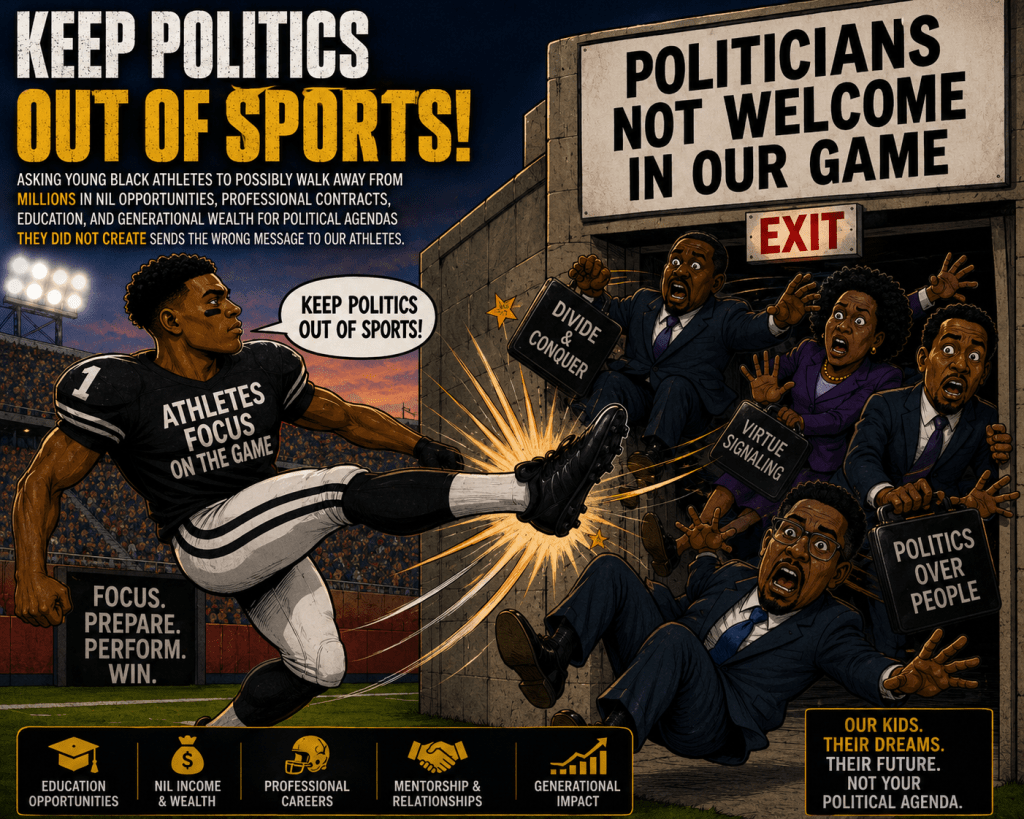
Asking young Black athletes to possibly walk away from millions in NIL (Name, Image, and Likeness) opportunities, professional contracts, education, and generational wealth for political agendas they did not create sends the wrong message to our athletes.
For years, Americans heard the same message from political leaders, activists, entertainers, and media personalities: “Keep politics out of sports.” When NFL players kneeled during the national anthem, many elected officials weighed in.
Immediately, critics argued politicians should stop interfering in athletics and allow athletes to focus on the game. Fast-forward to today, and many of those same political voices are now encouraging Black athletes to reconsider attending SEC schools for political reasons. That includes members of the Congressional Black Caucus and activist organizations publicly pressuring athletes to use their college decisions as political statements. So what changed? The answer, many Americans believe, is simple: politics in sports is acceptable when one side agrees with the message and unacceptable when the other side does it.
As a college coach, I have always believed politics should stay out of the locker room. Today, politics is trying to force its way into our locker rooms. Coaches are supposed to mentor, develop, and prepare young men and women for life — not turn athletes into political pawns for elected officials, activists, or media campaigns.
The SEC is not just another athletic conference. It is arguably the greatest professional sports pipeline in America. Every year, dozens of Black athletes from SEC schools turn professional. For many families, athletics represent an opportunity to escape poverty, build wealth, and change generations. Beyond professional sports, SEC athletics also open doors in broadcasting, coaching, business, marketing, corporate leadership, and entrepreneurship through powerful alumni and NIL networks. Most athletes are not trying to become political activists. They are trying to earn scholarships, develop professionally, support their families, build careers, and maximize opportunities. Athletes absolutely have the right to express themselves politically, but there is a major difference between supporting athlete expression and pressuring athletes to become political tools.
One of the arguments being used to justify calls for athletes to avoid SEC schools is that Black voters in some Southern states are being politically marginalized through redistricting maps and majority-minority districts. That is a legitimate political debate worth having. But there is another reality that also deserves honesty. Many majority-minority districts across America have historically struggled with underinvestment, weaker infrastructure, lower-performing schools, fewer economic opportunities, lower home values, and limited access to resources compared to wealthier districts. Those issues did not begin with college athletics, and they will not be solved by asking athletes to boycott SEC schools. If political leaders truly want to improve Black communities, then the focus should be on strengthening schools, increasing economic investment, supporting Black-owned businesses, rebuilding infrastructure, improving public safety, and expanding leadership opportunities. In my experience as a coach, I struggle with the idea of telling young Black athletes to walk away from scholarships, NIL opportunities, national exposure, and possible professional careers because politicians failed to solve problems that have existed for decades. Sports did not create most of these systemic issues. In many cases, sports have become one of the few remaining pathways out of those conditions.
Another argument being used to justify pressure campaigns against SEC schools is that diversity and DEI initiatives are being rolled back in some Southern states and universities. That is also a legitimate public policy discussion. But here is the uncomfortable part of the conversation that almost nobody wants to say out loud: the athletes generating billions of dollars for these universities and states are overwhelmingly Black males, yet Black men continue to be underrepresented in executive leadership, university administration, conference offices, and head coaching positions. That contradiction matters. From a coaching perspective, asking these same athletes to boycott the very system that may provide scholarships, NIL income, networking opportunities, professional exposure, and generational wealth — without first fixing the leadership and opportunity gaps around them — feels backwards. In many cases, sports have become one of the few systems where young Black men can still directly leverage talent into economic mobility at the highest level.
Another part of this conversation that gets overlooked is relationship capital. Black men who become successful in the corporate world, media, business, fundraising, coaching, or executive leadership often do so not simply because of degrees, but because of the relationships, alumni networks, mentorships, and exposure they gain at major universities and athletic programs. SEC schools are not just football factories. They are massive relationship networks connected to Fortune 500 companies, donors, media organizations, law firms, real estate developers, sports agencies, boosters, political leaders, and national business communities. Many athletes may never make the NFL, but the relationships they build at these schools can still change their lives forever. For many young Black men, athletics is not just about sports. It is about access — access to rooms, relationships, mentorship, and opportunities that historically were difficult to enter. That is why these decisions should stay focused on what is best for the athlete and their future, not political pressure campaigns created by adults far removed from the locker room.

If we are going to pressure SEC schools for anything, the conversation should focus on hiring more Black head coaches, athletic directors, conference executives, and university leaders. That is where real institutional power exists. Do not punish athletes trying to build futures for themselves and their families. Fix the leadership pipeline above them. Right now, many SEC football rosters are overwhelmingly Black while leadership at the top often does not reflect the athletes on the field. That is a fair conversation worth having. But telling young Black athletes to avoid the very schools that may give them the best chance at NIL success, NFL opportunities, national exposure, relationship-building, and generational wealth sends the wrong message.
I find the position that politicians are putting Black athletes in extremely troubling. These are not seasoned politicians, activists, or media figures. These are 17- to 20-year-old young men trying to make some of the biggest decisions of their lives. They are trying to choose schools, build careers, earn degrees, support their families, and possibly create generational wealth through athletics. I beg the Black community: do not shame these kids for making what they believe is the best career choice for their future. I could not imagine being the parent of a blue-chip recruit right now and having politicians, activists, and public figures putting this type of political pressure on my child over where they decide to attend college. That is unfair. For many families, these opportunities are life-changing. A scholarship to an SEC school can lead to NIL income, professional sports opportunities, corporate relationships, mentorship, national exposure, and long-term career advancement far beyond athletics. These young athletes should not be forced to carry the weight of political agendas created by adults. My responsibility as a coach is to guide young people toward opportunity, growth, education, and long-term success — not pressure them into becoming political statements before they are even old enough to legally drink. At some point, we have to stop treating athletes like political tools and start treating them like young people with dreams, families, and futures.
Are we going to publicly shame 17- and 18-year-old kids for signing with Alabama, Georgia, LSU, Florida, Texas, or other SEC schools because they chose the best opportunity for their future? Are athletes now supposed to turn down scholarships, NIL opportunities, national exposure, and possible professional careers to satisfy political agendas created by adults? These are young athletes trying to change their lives and their families’ futures — not political activists running campaigns.
America cannot continue operating under two different standards: condemning political involvement in sports when conservatives speak while celebrating it when progressive activists or elected officials do the same thing. If politicians truly believe sports should remain separate from politics, then that principle should apply equally to everyone. At the end of the day, athletes deserve the freedom to focus on their future — not somebody else’s political campaign.

