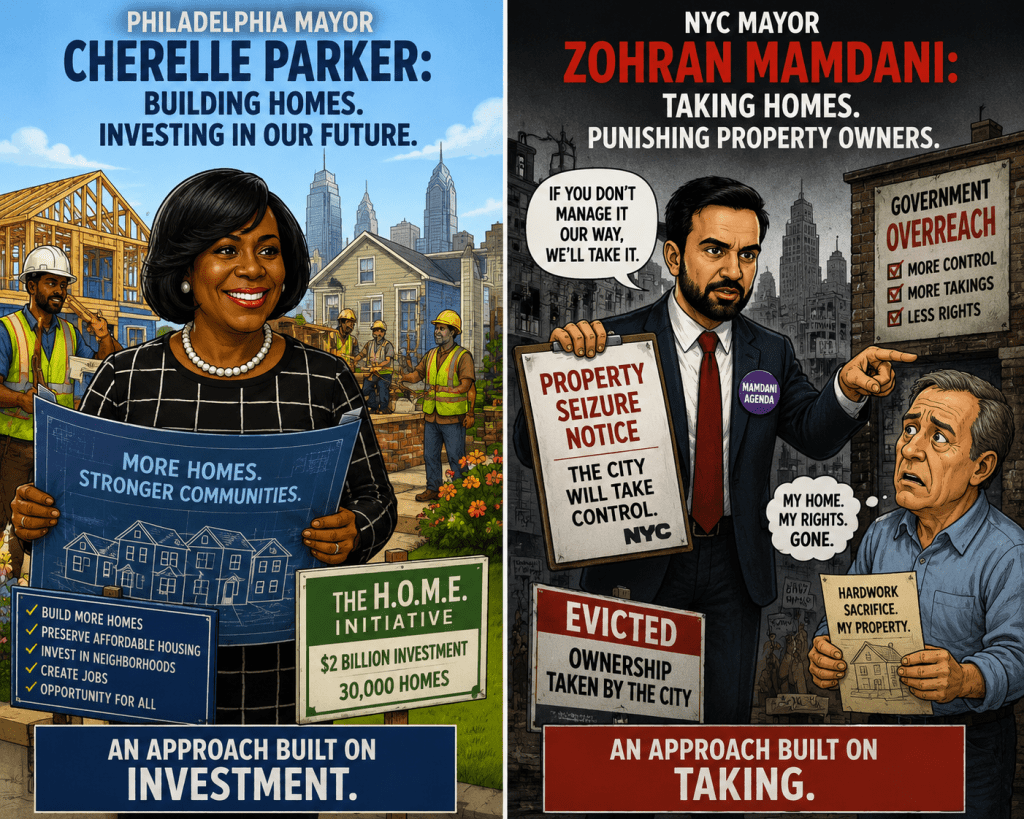
As Philadelphia Mayor Cherelle Parker invests in building housing, New York City Mayor Zohran Mamdani’s proposal raises new questions about government power, property rights, and who should control the future of affordable housing.
By James Williams | The Uptown Standard Opinion
There is no question that America faces a housing crisis.
From Philadelphia to New York City, working families are struggling with rising rents, increasing home prices, and a shortage of affordable housing. Elected officials across the country are searching for solutions, and both Mayor Cherelle Parker and Mayor Zohran Mamdani have made housing a centerpiece of their agendas.
The goal is the same.
The approach is not.
Mayor Parker: Building Housing Through Investment
Mayor Parker’s H.O.M.E. initiative is fundamentally an investment strategy.
Her administration has focused on increasing housing supply through new construction, preserving existing housing stock, supporting home repairs, utilizing city-owned land, and encouraging public-private partnerships to create more housing opportunities for Philadelphia residents.
Whether one agrees with every detail of the plan or not, the philosophy is clear: build more housing, create more opportunities for homeownership, and strengthen neighborhoods through investment.
The premise is straightforward. If cities want housing costs to stabilize, they need more housing. More homes mean more choices for residents and greater opportunities for families to build wealth through ownership.
Philadelphia’s approach seeks to expand opportunity through growth.
Mayor Mamdani: Housing Through Government Intervention
Mayor Mamdani’s housing proposal seeks to address many of the same affordability challenges facing New York City.
However, his administration has also proposed aggressive action against negligent landlords, including efforts to transfer certain troubled properties to tenants, nonprofits, or community land trusts through legal processes.
Supporters call this accountability.
They argue that landlords who repeatedly fail to provide safe housing should face serious consequences and that alternative ownership models may better serve residents.
No reasonable person supports slumlords.
Property owners who neglect buildings and place tenants at risk should be held accountable through code enforcement, court action, fines, and other legal remedies.
But there is an important distinction between regulating property and transferring ownership.
That distinction is where concerns begin to emerge.
Two Mayors, One Goal, Very Different Approaches
To be fair, both mayors are attempting to solve the same problem.
Both want more affordable housing.
Both want residents to have access to safe and stable homes.
Both believe government has a role to play in addressing housing shortages.
The difference is in their methods.
Mayor Parker’s strategy asks: How do we build more housing?
Mayor Mamdani’s proposal increasingly asks: How do we determine who should own housing?
That may seem like a subtle distinction, but it carries significant implications for property rights, investment, and the relationship between government and private ownership.
Property Rights and the Slippery Slope Question
One reason Americans have historically been protective of private property rights is that government power tends to expand over time.
Throughout history, governments of various political ideologies have justified greater control over private property in the name of the public good. The justification is often noble—public safety, economic fairness, affordability, or helping those in need.
The concern is not the stated goal.
The concern is the precedent.
Who determines when an owner has lost the right to keep their property?
What safeguards exist for owners who are struggling financially but trying to comply with regulations?
What happens when future administrations decide to expand those powers beyond their original purpose?
These are not partisan questions.
They are fundamental questions about the balance between public policy and private property rights.
Why Philadelphia Should Choose Investment Over Intervention
Philadelphia’s housing challenges are real.
The city needs more affordable housing. It needs stronger neighborhoods. It needs pathways to homeownership and opportunities for working families to remain in the communities they helped build.
Mayor Parker’s investment-focused approach may not be perfect, but it is focused on expanding housing opportunities without fundamentally altering private ownership rights.
That is a critical distinction.
Building more housing and encouraging investment strengthens communities.
Expanding government’s role in determining who owns property creates a very different set of questions.
Both Philadelphia and New York are pursuing the same destination.
But they are traveling very different roads.
Housing for all is a worthy goal.
Property rights should not be the price we pay to achieve it.

