By JA Williams Jr
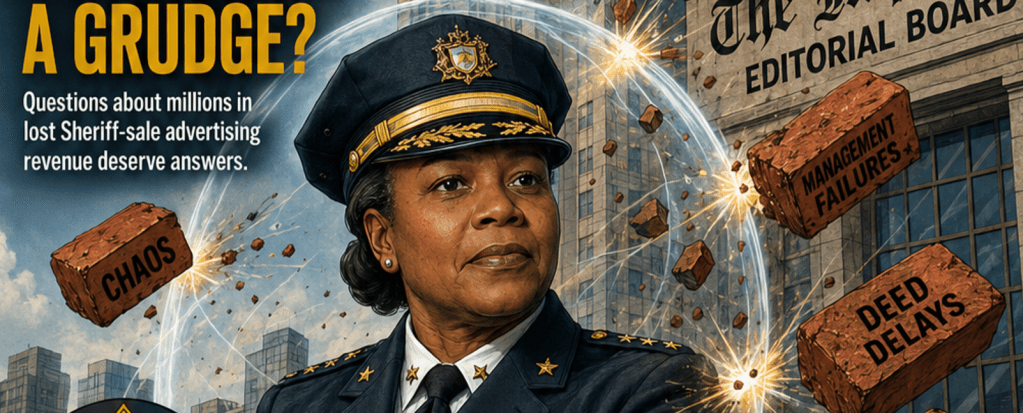
Questions about millions in lost Sheriff-sale advertising revenue deserve answers.
The Philadelphia Inquirer has every right—and responsibility—to scrutinize Philadelphia Sheriff Rochelle Bilal. The Sheriff’s Office performs important public functions, handles public money and answers to Philadelphia voters. Questions involving sheriff sales, deed processing, spending and court operations are legitimate subjects for aggressive journalism.
But accountability should work both ways. When a newspaper repeatedly scrutinizes an elected office, readers can also reasonably examine the newspaper’s history with that office and ask whether that history is relevant to the coverage.
That brings us to a financial relationship that deserves more attention: Sheriff-sale advertising.
In 2018, The Inquirer reported that Philadelphia Media Network, then publisher of The Inquirer and Daily News, received approximately $1.6 million from the Philadelphia Sheriff’s Office for advertising during fiscal year 2017. The same reporting said the Sheriff’s Office had spent roughly $41 million advertising sheriff sales across numerous newspapers over a five-year period.
Those numbers raise straightforward questions.
How much Sheriff-sale advertising revenue did The Inquirer receive during the final years of Sheriff Jewell Williams’ administration?
How much did it receive after Rochelle Bilal took office in January 2020? When did those payments decline substantially or stop?
And if a significant commercial relationship changed, should that history be disclosed when the newspaper publishes extensive critical reporting about the official whose administration changed those advertising practices?
None of those questions proves retaliation. A change in advertising revenue does not establish that journalists or editors altered coverage because of money. But the existence of a substantial prior financial relationship makes transparency particularly important.
Bilal herself has publicly raised the issue. She has argued that reducing Sheriff-sale advertising expenditures contributed to hostile media coverage of her administration.
Her assertion should not simply be accepted as fact. It should be tested against the records.
That means examining invoices, contracts, payment records and advertising expenditures before and after 2020. The public should be able to see the numbers and draw its own conclusions.
There is also the question of language.
Recent Inquirer coverage has used unusually forceful framing. An August headline described Bilal’s tenure as “six years of chaos.” Other coverage has prominently featured phrases including “slush fund” and “an embarrassment,” while reporting extensively on deed delays, management decisions and financial questions.
The underlying issues may deserve investigation. But readers can still ask whether the cumulative language moves beyond reporting facts and toward constructing a predetermined narrative.
How many neutral or positive stories about the Sheriff’s Office have appeared during the same period? When the office announces reforms, modernization initiatives or technological improvements, are those developments investigated and displayed with comparable prominence?
When Bilal disputes an allegation, where in the story does her response appear? When an allegation is later clarified, does that clarification receive comparable attention?
Those are measurable questions.
Another factor makes the discussion more complicated: The Inquirer’s Editorial Board has repeatedly advocated abolishing the Philadelphia Sheriff’s Office.
Editorial boards are separate from newsrooms, and that distinction matters. An editorial represents an institutional opinion; a news report is supposed to operate under different standards. It would therefore be unfair to automatically assume that an editorial position dictates newsroom coverage.
Still, readers may reasonably ask what safeguards exist between those functions when the newspaper’s editorial arm has openly advocated eliminating the same elected office its reporters are aggressively investigating.
Does the newsroom maintain complete independence from that institutional position? How is that separation enforced?
Would greater disclosure strengthen public confidence?
These questions are especially important because local journalism depends on credibility. Newspapers properly demand transparency from government. Government officials should expect tough questions, public-record requests and uncomfortable reporting.
News organizations should also be willing to answer reasonable questions about their own financial history and editorial practices.
This is not an argument that Sheriff Bilal should receive favorable coverage. If deeds are delayed, report it. If courts identify operational failures, report them. If public money is improperly spent, follow the money wherever it leads.
But the same principle applies in the opposite direction.
If a newspaper once received substantial revenue from the government office it now covers aggressively, follow that money too.
The central question is therefore not whether The Inquirer should investigate Rochelle Bilal. Of course it should.
The questions are whether readers are receiving the complete context, whether the newspaper’s past financial relationship with the Sheriff’s Office deserves disclosure, and whether the tone and volume of its coverage reflect proportionate accountability journalism.
We are not declaring that The Inquirer is holding a grudge.
We are asking something journalism itself teaches us to ask:
What do the records show?
 Uptown Standard