By James Williams
I was a fan of John Fetterman the first time I heard him speak about cannabis legalization. The work he did on prison commutations — granting second chances to people who had paid their debt to society — showed moral courage that many mistook for radicalism. In truth, that compassion and independence are what make him a centrist. Like most pragmatists, Fetterman holds a mix of liberal and conservative views, which naturally upsets both sides of the political spectrum. But this moment in American politics is bigger than party loyalty. What we’re seeing isn’t about Democrats or Republicans — it’s about pragmatism over ideology.
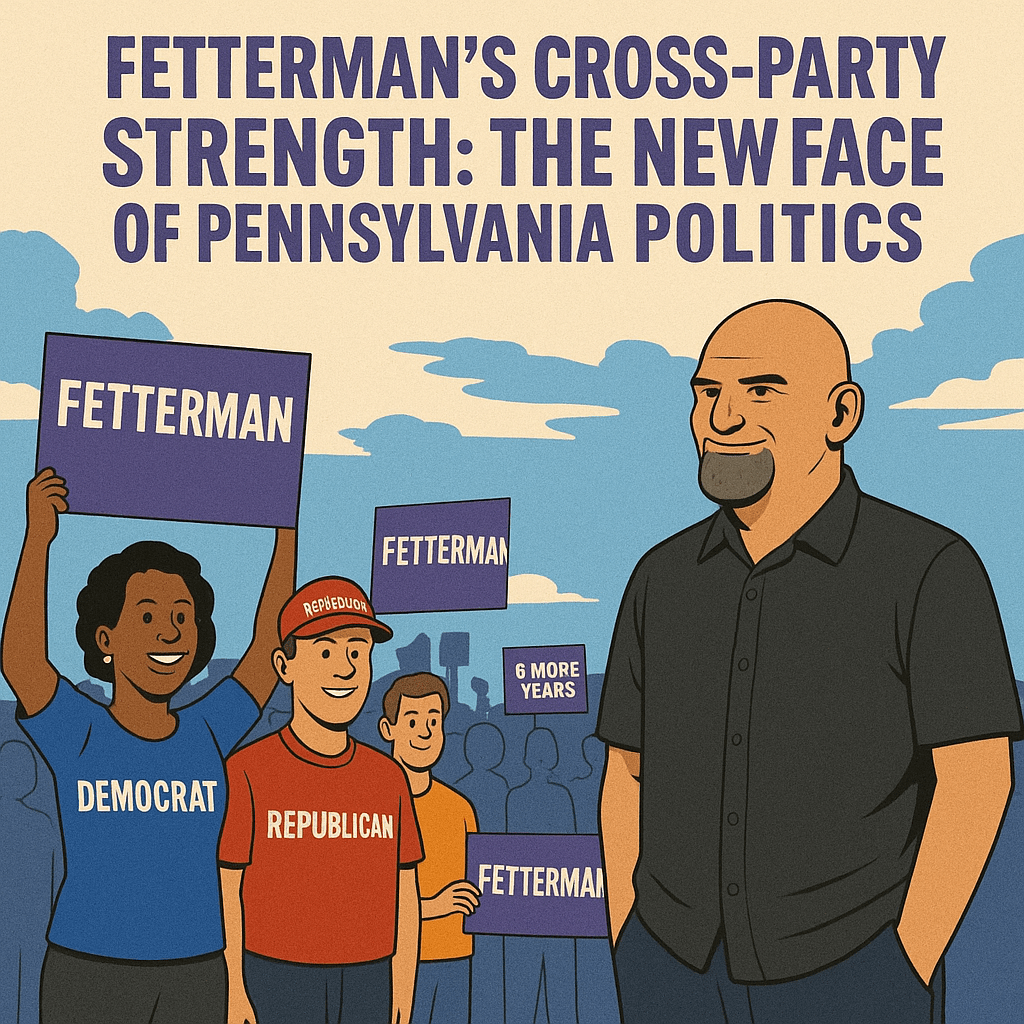
In an era of deep political division, few leaders can bridge the partisan gap, but Senator John Fetterman is doing just that. A recent Quinnipiac University poll from October 2025 paints a remarkable picture of Fetterman’s statewide appeal. Not only does he maintain solid support among Democrats, he’s also winning over Republicans and Independents — a rare feat in today’s polarized climate. The poll found that sixty-two percent of Republicans approve of Fetterman’s job performance, fifty-four percent of Democrats support his leadership, and forty-three percent of Independents approve, with another forty-three percent neutral. That balance tells the story of a senator who represents something increasingly rare — authenticity that transcends party lines.
Fetterman’s rise to national attention didn’t begin in Washington; it started in Braddock, Pennsylvania, where, as mayor and later lieutenant governor, he championed issues that most politicians avoided. One of his earliest and most passionate causes was cannabis legalization. He launched a 67-county listening tour to hear directly from Pennsylvanians — from farmers and police officers to working families and veterans — about their views on marijuana policy. What he found was overwhelming bipartisan support for legalization, not just as a matter of personal freedom, but also as an issue of economic opportunity and criminal justice reform.
He argued that cannabis should be legal nationwide for jobs, veterans, farmers, and tax revenue, and that nonviolent marijuana convictions should be expunged so that people could fully rejoin society without being branded by a record. This practical, people-first approach earned him national attention and showed that his politics weren’t about scoring ideological points, but about solving real problems that affect real people. In many ways, his position on cannabis legalization captures his broader philosophy. He views it as both smart policy and economic common sense, and that combination — compassion, data, and directness — reflects why so many Republicans, Democrats, and Independents find common ground in his leadership.
Positions like cannabis reform and criminal justice initiatives often made Fetterman a favorite among progressives, especially when paired with his trademark hoodies and Dickies suits that symbolized working-class authenticity. But that image also created a misunderstanding. Many assumed he was part of the progressive movement when, in truth, he was never a pure ideologue. Pragmatism and progressivism are not the same. Fetterman’s political DNA has always been rooted in realism — finding solutions that work, not just those that make headlines. So when he broke from his party to support the continuing resolution and keep the government open, it wasn’t betrayal; it was consistency.
For those on the far left, his vote to end the shutdown looked like a reversal, but in reality, it was a reflection of who he’s always been — a centrist pragmatist who believes in governing for all Pennsylvanians, not just for one ideological wing of his party. When the federal government faced another shutdown, Fetterman took a stand that surprised some and impressed many. Breaking with Democratic leadership, he voted to keep the government open, emphasizing that working families, federal employees, and SNAP recipients shouldn’t be pawns in a political standoff. Critics on the far left saw it as a surrender of leverage, but moderates and independents saw something else: leadership rooted in common sense, not ideology.
That decision reinforced Fetterman’s image as an independent voice — someone who votes for Pennsylvania, not just his party. For all the political grandstanding that dominates headlines during a government shutdown, the real story isn’t about ideology; it’s about real people, real jobs, and real consequences. In Pennsylvania alone, more than 101,000 civilian federal employees call the Commonwealth home — people who keep our airports, national parks, and federal offices running every day. Roughly two million residents, or about fifteen percent of the state’s population, rely on SNAP benefits each month to feed their families. Over six thousand state workers depend directly on federal program funding for their salaries, which means every day the shutdown continues, paychecks and vital services are at risk. More than $1.2 billion in federal grant funding to Pennsylvania agencies has been frozen, stalling projects in education, transportation, and public health.
Economists can’t yet tally the exact hit to the state’s finances, but the potential losses are staggering. Pennsylvania spends about $45 billion annually in federally funded programs. With each week of a shutdown, the state risks losing millions in tax revenue — not because of politics, but because families can’t spend money they never received. Nationwide, analysts warn that prolonged federal funding cuts could lead to as much as $9 billion in lost state and local tax revenue by 2026. For Pennsylvania, that could mean hundreds of millions in reduced income and sales tax collections, not to mention the ripple effects on small businesses, landlords, and local economies that depend on steady paychecks and public programs.
From TSA agents and air traffic controllers working without pay to contractors and program administrators facing furloughs, these aren’t faceless government workers — they’re our neighbors, church members, and parents trying to keep the lights on. When politicians in Washington play ideological games, it’s these men and women who shoulder the burden. That’s exactly what Fetterman understood when he voted to end the shutdown. His message wasn’t about political loyalty; it was about economic reality.
Fetterman’s independence doesn’t stop there. Over the past two years, he has repeatedly proven that he’s not afraid to challenge Democratic orthodoxy when principle or practicality demands it. He joined a small group of Democrats and one Independent in voting for the stop-gap funding bill to reopen the government, even as many in his party resisted. On foreign policy, Fetterman has taken a centrist, pro-Israel stance during the Gaza conflict, standing apart from progressives who called for an immediate ceasefire. He’s also been more hawkish on Iran and national security than his party’s left flank. On immigration, while he supports DACA and humane reform, he has also called for stronger border enforcement — a position that contrasts sharply with progressive Democrats. He has even gone as far as rejecting the “progressive” label altogether, saying plainly, “I’m just a Democrat who tells the truth.” These moments don’t reveal inconsistency; they reveal independence — a senator willing to take positions that make sense for his state rather than for party strategists or social media activists.
Fetterman’s political character brings to mind another Pennsylvania senator who defied party expectations: Arlen Specter. Specter, a Philadelphia native, spent decades defining what it meant to be a moderate statesman. Like Fetterman, he understood that leadership meant representing the entire Commonwealth, not just the loyalists of one party. Specter’s most famous break came when his Republican vote helped pass the Affordable Care Act, a decision that cost him dearly with GOP loyalists but was driven by conviction. Fetterman’s recent vote to end the government shutdown isn’t as historic as the Obamacare vote, but the reaction feels familiar. Both men were criticized by their party’s purists for crossing the aisle, and both acted out of principle, not politics.
In his memoir Life Among the Cannibals, Specter wrote about the partisanship that consumed Washington — a warning that reads today like prophecy. In an age where cooperation is punished and extremism is rewarded, Specter’s wisdom feels newly relevant. Like Specter before him, Fetterman seems to understand a fundamental truth about Pennsylvania politics: our senators are elected to serve all Pennsylvanians — not just one party. His willingness to put the Commonwealth’s interests first, even when it means challenging his own party, may very well define the next era of leadership in Pennsylvania.

