By James Williams
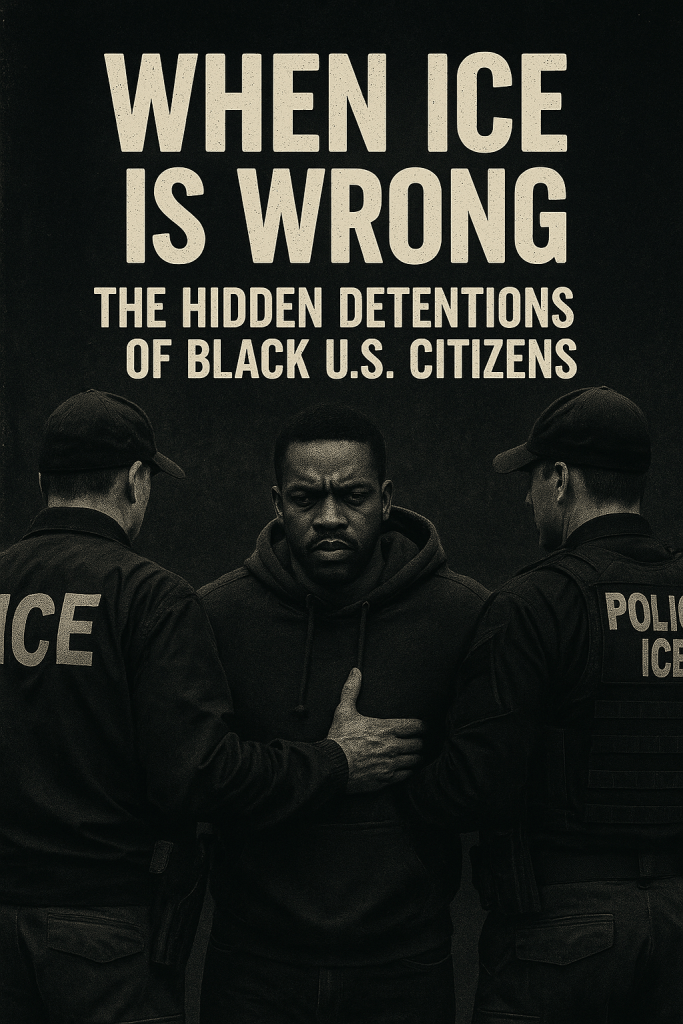
For years, America’s immigration debate has focused on walls, borders, and political rhetoric. But there’s a quieter story — one far more disturbing — that rarely makes the front page. Black U.S. citizens, born and raised in this country, have been wrongfully detained, jailed, and even deported by Immigration and Customs Enforcement (ICE).
This is not new. It did not begin under Donald Trump. The problem goes back decades, through multiple administrations, Republican and Democrat alike. What we are witnessing today is not an anomaly; it is the continuation of a system that was flawed from the start — one that confuses race with nationality and color with citizenship.
The Roots of a Systemic Failure
After the September 11th attacks, the federal government merged several agencies under the new Department of Homeland Security. ICE was created in 2003, charged with protecting national security through immigration enforcement. From the beginning, the agency’s databases were incomplete, inaccurate, and racially biased. Black Americans, particularly those of Caribbean or African descent, were disproportionately flagged as “foreign” because of their names, accents, or family heritage.
Under the Bush and Obama administrations, ICE expanded its powers through programs such as Secure Communities and the Criminal Alien Program, which linked local police fingerprint data to federal immigration databases. The goal was to catch undocumented immigrants. The result was that U.S. citizens were being detained before anyone verified who they were.
When Citizenship Isn’t Enough
The victims of these wrongful detentions share a common experience: they all had proof of citizenship, but ICE refused to believe them.
Mark Lyttle, born in North Carolina, was deported to Mexico in 2008 and held for months in Central America before officials discovered their mistake. Bronx-born citizen Garfield Kennedy was detained for six days despite carrying valid identification. In 2011, Davino Watson — a U.S. citizen — was held for nearly four years in ICE custody, even after repeatedly showing documentation of his citizenship.
Each case exposed the same pattern: an overreliance on flawed databases, a lack of accountability, and a system quick to detain but slow to verify.
A 2011 UC Berkeley study found that ICE’s detainer system likely resulted in the wrongful detention of hundreds of U.S. citizens each year — disproportionately Black and Latino.
A Modern Problem With Old Roots
In 2025, the problem persists. According to federal data, ICE detention centers currently hold nearly 60,000 people, more than 70 percent of whom have no criminal convictions. From October 2024 through June 2025, over 200,000 individuals were booked into ICE custody, with 93 percent lacking any violent offenses.
Among them were citizens.
In May 2025, a federal court ruled in favor of Peter Sean Brown, a Philadelphia-born American who was held for deportation to Jamaica despite providing proof of citizenship. Nineteen-year-old Jose Hermosillo, a U.S. citizen, was detained in Arizona for 10 days before his family secured his release. And Cary López Alvarado, a pregnant U.S. citizen, was allegedly shackled and forced into premature labor while detained this past June.
These are not isolated cases; they are warnings about what happens when enforcement power grows unchecked and when citizenship verification becomes an afterthought.
The Overlooked Victims: Black Hispanics
One of the most invisible groups affected by this crisis are Black Hispanics — Afro-Latinos — who live at the intersection of race and ethnicity. On paper, “Black” and “Hispanic” are separate categories, but in reality, Afro-Latinos are profiled twice: first as Black by local police, then as foreign by ICE.
A dark-skinned Dominican, Puerto Rican, or Panamanian is more likely to be seen as both “criminal” and “noncitizen.” This double bias leaves Afro-Latinos especially vulnerable in an enforcement system that fails to recognize multiracial or multiethnic identities.
Across the Americas, African ancestry and Latino identity have always been intertwined. The Caribbean and Latin America were central to the transatlantic slave trade. Millions of people in the region today have African roots — yet in the United States, those identities are often erased.
In the Dominican Republic, roughly 80 percent of citizens have African ancestry, yet darker-skinned Dominicans often face suspicion in the U.S. as “foreign.” In Puerto Rico, African heritage defines the island’s music, cuisine, and religion, but darker Puerto Ricans experience higher rates of color-based profiling. Cuba has deep West African roots; Afro-Cubans migrating to the U.S. have long reported discrimination both at home and abroad. Panama and Honduras are home to Afro-Panamanians and Garifuna communities descended from African laborers and Indigenous peoples. Brazil and Colombia together have more than 100 million Afro-descendants — the largest populations of African heritage outside Africa.
Here in the United States, Afro-Latinos often find themselves invisible in the numbers but hyper-visible in enforcement. Government forms and data systems rarely recognize individuals who are both Black and Hispanic. The result is confusion, misclassification, and, in some cases, wrongful detention.
In the eyes of the system, Afro-Latinos are often seen as too Black to be Latino and too Latino to be Black.
A Decade of Denial
This issue didn’t suddenly emerge under Trump. His administration merely magnified it. A 2021 Government Accountability Office report found that between 2015 and 2020, ICE detained or deported at least 70 U.S. citizens — a period that includes the final year of Obama’s presidency. The machinery was already in motion; Trump simply turned up the volume.
This is a bipartisan failure that exposes a structural weakness in how America defines belonging. The danger is not just in policy but in perception — the assumption that “American” still looks a certain way.
Citizenship and Color
Even now, ICE has no public tracking system for wrongful detentions and no transparent mechanism to review or prevent them. Civil-rights advocates are pushing for reforms, including independent oversight, automatic citizenship verification before detainers are issued, and restitution for those who were wrongfully detained.
But the deeper issue remains cultural. Too often in this country, Blackness is treated as foreignness. Citizenship is treated as conditional — something to be proven, not presumed.
When ICE is wrong, the consequences are life-altering. Families are torn apart. Jobs are lost. People are stripped of their dignity by an agency that can take months to admit an error.
Until America confronts the racial bias embedded in its immigration enforcement, Black Americans — especially Black Hispanics — will remain at risk of losing their freedom in their own country.
When ICE is wrong, the damage is irreversible. And when the victims are Black Americans, it reveals something deeper — that in America, citizenship is still not color-blind.

