By James Williams
Editor-in-Chief, The Uptown Standard
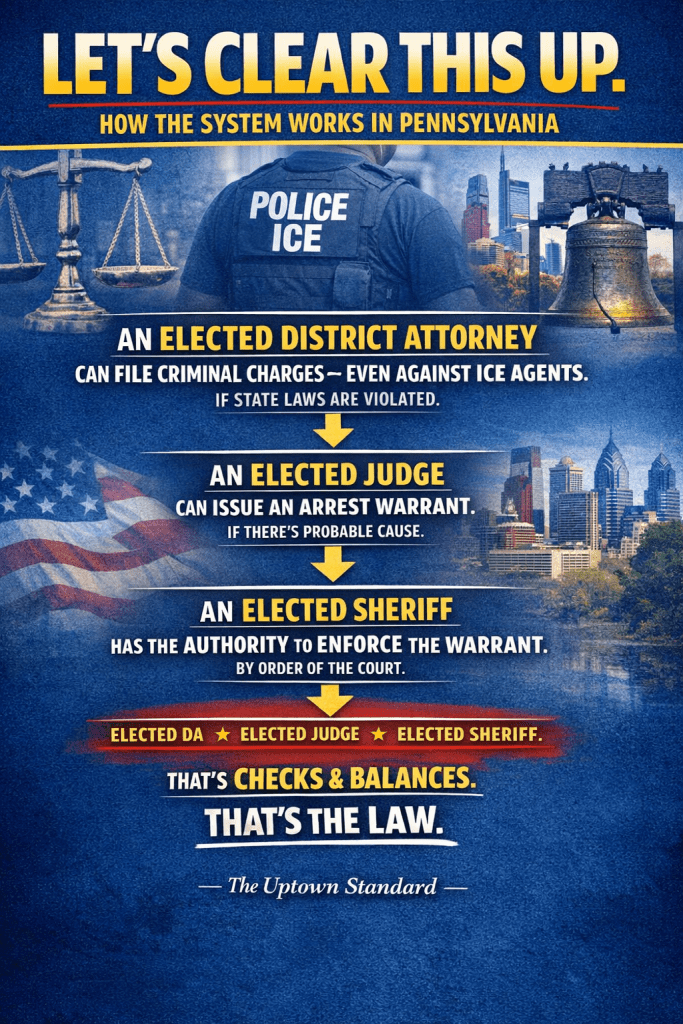
Over the past several days, memes and commentary—largely from right-wing websites and social media—have targeted Rochelle Bilal and Larry Krasner, claiming that the Philadelphia Sheriff’s Office lacks the authority to arrest individuals, including federal ICE agents, even when a court issues a warrant. That claim is false, and it reflects a fundamental misunderstanding of jurisdiction, court authority, and how Pennsylvania’s criminal justice system actually functions.
This is not about personalities or partisan loyalty. It is about explaining the law as it exists today—plainly, accurately, and without distortion.
The Philadelphia Sheriff’s Office is a county law-enforcement agency established under Pennsylvania law. Its deputies are sworn officers with legally defined powers. While the Sheriff’s Office does not conduct routine street patrols or criminal investigations like the Philadelphia Police Department, it serves a different—and equally critical—role: enforcing the authority of the courts.
The Sheriff’s Office exists to execute judicial orders. That includes serving and executing arrest warrants, apprehending individuals named in court orders, transporting prisoners, providing court security, and enforcing judicial writs.
When a judge issues an order, the Sheriff’s Office is one of the agencies legally empowered to carry it out. This authority is not symbolic, discretionary, or political. It is structural.
The Philadelphia District Attorney’s Office does not arrest people. The District Attorney’s role is to investigate alleged violations of Pennsylvania law, file criminal charges when evidence supports them, present those charges to a judge, and request arrest warrants when probable cause exists. Only a judge can issue an arrest warrant. Once signed, that warrant becomes a binding court order, and at that point the process moves from prosecution to execution.
If the District Attorney files charges and a judge issues a valid arrest warrant, the Philadelphia Sheriff’s Office has the legal authority to make the arrest. That authority flows directly from the court. It does not depend on who the individual is, where they work, or whether the arrest is politically popular. Executing court-ordered arrests is a core function of the Sheriff’s Office under Pennsylvania law.
As confusion spread online, Kevin Bethel clarified the division of responsibility between the Police Department and the Sheriff’s Office, explaining that the City of Philadelphia is policed by the Philadelphia Police Department, which handles patrol, criminal investigations, emergency response, and enforcement of state and local laws, while the Sheriff’s Office is a separate entity whose mission includes court security, service of legal process, prisoner transport, fugitive apprehension, and sheriff’s sales. Read in full context, that explanation does not deny arrest authority—it defines roles.
It is also important to be clear about intent. Commissioner Bethel was not attacking another Democrat, nor was this a Black male law-enforcement leader targeting a Black female law-enforcement leader. That framing is unnecessary and inaccurate. His remarks were reasonable, measured, and professional, focused on explaining the distinct responsibilities of each office. At no point did he say—or even suggest—that the Sheriff lacked the power to arrest.
By acknowledging fugitive apprehension and prisoner transport, the Commissioner necessarily acknowledged functions that cannot exist without lawful arrest authority exercised pursuant to court orders. You cannot apprehend fugitives or transport prisoners without the legal power to detain individuals named in warrants. The Police Department investigates and patrols. The Sheriff’s Office enforces judicial authority. These roles are different, but complementary.
What people also need to understand is that the way the Philadelphia Police Department interacts with ICE in routine situations is no different than how non-political police departments interact with the FBI or the ATF. Local police do not set federal immigration policy, nor do they act as an enforcement arm of federal agencies by default. Their role is limited, procedural, and defined by law.
That distinction has been explained clearly by police leaders across the country, including Larry Snelling, who recently went viral for calmly outlining how cooperation with ICE is supposed to work: local police respond to local crime, federal agencies handle federal matters, and information-sharing occurs within legal boundaries—not political theater. That framework mirrors long-standing relationships with agencies like the FBI and ATF.
What is different—and what many commentators are deliberately conflating—is when the courts step in.
When an elected District Attorney files criminal charges and an elected judge issues an arrest warrant, that is not executive discretion or inter-agency cooperation. That is the judicial branch in action, responding to what it has determined may be an unlawful offense under state law. At that point, enforcement is no longer about federal cooperation or local policy preferences. It is about court authority.
And that distinction matters.
In Philadelphia, this process involves elected officials at every step: an elected District Attorney filing charges, an elected judge issuing a warrant, and an elected Sheriff making the arrest. These are not mayoral appointees acting at the direction of City Hall. They are independent constitutional officers exercising authority vested in them by voters and by law.
If a case like this were to proceed, it would not represent chaos or lawlessness. It would represent checks and balances functioning exactly as designed. It could also have broader implications, potentially shaping how federal and state authority interact going forward and clarifying the limits of executive power when judicial findings of unlawful conduct are involved.
That isn’t politics.
That’s the system working.
 Uptown Standard