By James Williams
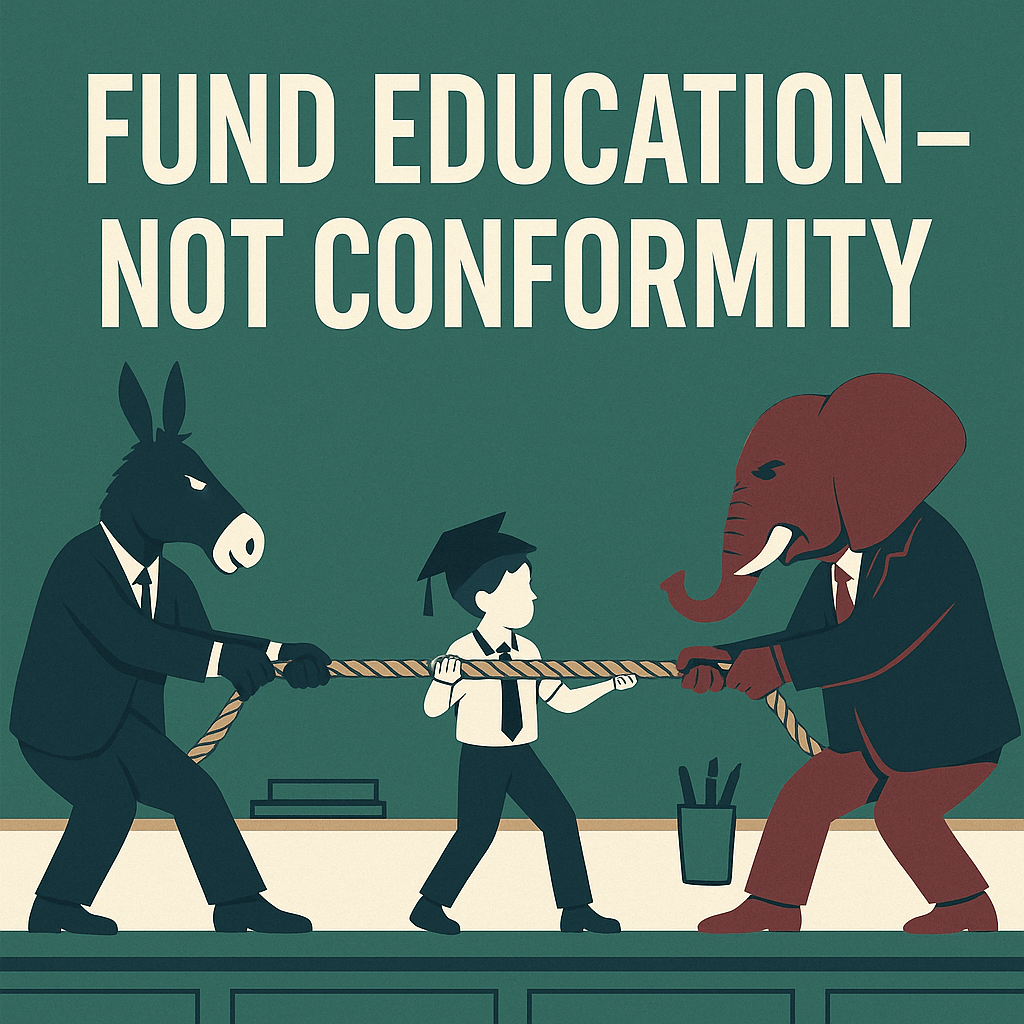
For more than two decades, I have worked in both athletics and higher education fundraising. Those experiences taught me that universities thrive when they pursue truth, excellence, and opportunity—not ideology. Yet today, both major political parties have turned education into a political stage, using policy and funding as tools of control.
Biden’s Title IX Changes — Defying Biology
As a coach, I believe fairness, safety, and evidence must guide athletic competition. When the previous administrationp reinterpreted Title IX to include gender identity under the definition of “sex,” it replaced clear biological standards with subjective ones. The goal may have been inclusion, but the outcome was confusion.
A 2023 review in Frontiers in Sports & Active Living found that transgender women retained greater average height and grip strength than cisgender women even after years of hormone therapy, while endurance traits changed more quickly. Such mixed evidence shows how complex it is to design fair policies in sport without clear, science-based rules. Coaches, athletes, and parents alike need clarity that balances inclusion with fairness. Any rule that defies biology risks undermining the very equity it claims to protect.
Trump’s Funding Threat — Extorting Academia
Now, under the current administration, higher education faces the opposite—but equally troubling—pressure. The proposed Compact for Academic Excellence would condition research grants and contracts on whether universities agree to a defined set of ideological terms. For many in academia, that approach feels less like reform and more like financial coercion. When funding is contingent on political loyalty, the result is extorting academia, not reforming it.
An Inside Higher Ed survey in 2025 found that 22 percent of provosts said government actions had already affected academic freedom, while half reported “increasing challenges.” At Harvard, 85 percent of faculty cited government pressure as the greatest threat to scholarly independence. No matter which party holds power, tying dollars to doctrine corrodes the integrity of higher education.
Philanthropy and Mission
As a former major gifts officer, I’ve seen how donor confidence depends on trust in a school’s independence. Donors give because they believe in a mission—educating the best students, regardless of background—not because they support one political camp over another. When universities become ideological battlegrounds, fundraising suffers.
According to Gallup, public confidence in higher education has dropped to just 36 percent. The Manhattan Institute reports that 64 percent of Americans now want universities to emphasize “truth over ideology.” Philanthropy thrives on purpose, not politics. The moment schools become instruments of ideology—left or right—they risk losing both their donors and their direction.
Freedom Over Control
Academic freedom has long been a cornerstone of American democracy. It allows institutions to challenge ideas, pursue evidence, and innovate without fear of government interference. Both recent policies—the Title IX reinterpretation and the new funding compact—violate that principle from opposite directions. One replaces science with psychology; the other replaces autonomy with compliance.
Education cannot thrive under ideological rule, no matter its source. It thrives when truth, fairness, and intellectual independence come first. If America wants its universities to lead the world again, both parties must learn the same lesson: fund education, not conformity.
Echoes of McCarthyism
The tension between politics and academic freedom isn’t new. In the early 1950s, during the McCarthy era, universities came under intense scrutiny as Congress investigated alleged communist influence in higher education. Professors were questioned about their political beliefs, pressured to sign loyalty oaths, and sometimes dismissed simply for expressing unpopular opinions. The government didn’t need to control funding to control thought—fear did the work instead.
That period taught a painful lesson: when political leaders decide which ideas are permissible, truth becomes a casualty. McCarthyism ended careers, silenced debate, and chilled intellectual curiosity for a generation. What made it so corrosive was not just the accusations but the assumption that dissent was disloyalty.
Today, the tools have changed—regulations, funding contracts, and executive directives have replaced loyalty oaths—but the impulse is the same. Both parties are tempted to use federal authority to make universities conform to their preferred worldview. Whether it’s redefining civil rights law or conditioning research dollars on ideology, the outcome is a narrowing of thought that echoes the very censorship America once condemned.
Academic freedom has always been fragile. It depends on the courage of educators to teach, the integrity of institutions to resist pressure, and the restraint of government to respect independence. When those boundaries blur, we risk repeating the mistakes of the past—trading open inquiry for political compliance.
If the McCarthy era stands as a warning, it’s that the pursuit of truth cannot survive in a climate of fear or control. Education must remain a forum for questioning, not obedience. And that principle must hold—no matter which administration holds power.
Sources: Frontiers in Sports & Active Living (2023); Inside Higher Ed Provost Survey (2025); Harvard Crimson Faculty Survey (2025); Gallup Higher Education Confidence Poll (2025); Manhattan Institute Higher Education Survey (2025); AAUP Academic Freedom Report (2025).
 Uptown Standard