By James Williams
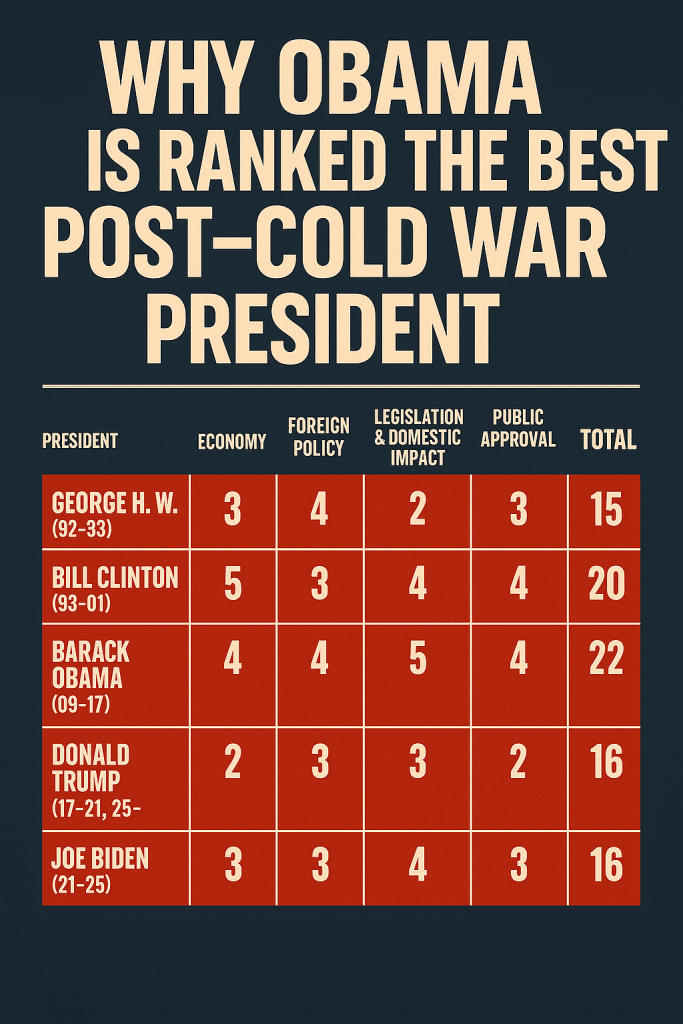
Since the Cold War ended, America has been led by six presidents navigating new global realities. When evaluated across economy, foreign policy, domestic legislation, public approval, and legacy potential, Barack Obama emerges at the top. But each president made lasting marks, for better or worse.
George H. W. Bush steered America through the Gulf War, assembling a broad coalition that liberated Kuwait in 1991 with limited U.S. casualties. He signed the Americans with Disabilities Act, expanded the Clean Air Act, and helped manage the peaceful end of the Cold War. Yet, a faltering economy and his reversal on the “no new taxes” pledge hurt him, costing reelection after one term.
Bill Clinton presided over one of the strongest economic booms in U.S. history, with balanced budgets, deficit reduction, and job growth. The North American Free Trade Agreement reshaped trade, while welfare reform and crime legislation left mixed legacies. Internationally, he led NATO interventions in Bosnia and Kosovo. Clinton’s approval ratings stayed high, but his presidency was marred by impeachment over the Monica Lewinsky scandal.
George W. Bush’s presidency was defined by September 11, 2001. His decisive early leadership united the country, but his wars in Afghanistan and Iraq dragged on for decades with high costs. Domestically, he cut taxes, launched the No Child Left Behind Act, and expanded Medicare to include prescription drugs. His response to Hurricane Katrina and the 2008 financial crisis damaged his credibility and legacy.
Barack Obama inherited the Great Recession and stabilized the economy with the stimulus package and auto industry rescue. His signature achievement, the Affordable Care Act, expanded healthcare access to millions. He advanced marriage equality, strengthened Wall Street oversight, and ended “Don’t Ask, Don’t Tell.” Internationally, he ordered the raid that killed Osama bin Laden, negotiated the Iran nuclear deal, and improved America’s global image. His leadership style and enduring popularity secure him the top ranking.
Donald Trump, now in his second term as the current president, has defined his presidency through disruption and ongoing influence. He cut taxes, appointed three Supreme Court justices, and pursued “America First” policies, including trade wars and renegotiating NAFTA into the USMCA. His first term included a strong pre-COVID economy but a chaotic pandemic response and two impeachments. His second term continues to reshape the Republican Party and American politics, making his legacy still very much in progress.
Joe Biden led America through pandemic recovery, overseeing mass vaccination and an economic rebound. His Infrastructure Investment and Jobs Act was the largest infrastructure bill in decades. He restored international alliances, managed support for Ukraine against Russian aggression, and passed the Inflation Reduction Act, a landmark climate and healthcare law. While his approval ratings fluctuated, Biden’s accomplishments suggest a steady, if understated, presidency.
Obama’s combination of legislative achievement, measured diplomacy, and enduring popularity places him ahead of his peers. His presidency not only reshaped domestic life but also recalibrated America’s place in the world — a benchmark for future leaders.
 Uptown Standard