By James Williams
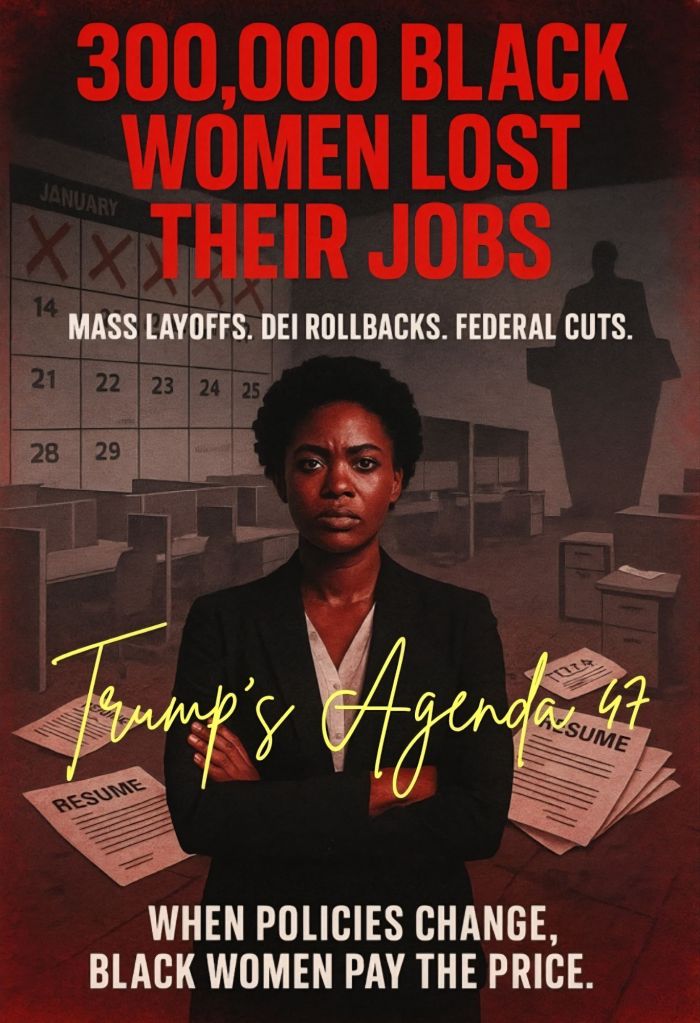
This alarming trend was first spotlighted in a vlog by John Hope Bryant, founder of Operation HOPE, who has long warned of the economic fragility facing Black women in America. In his words: “In the last 6–8 months, 300,000 Black women have lost corporate and government jobs. That’s not just a stat — that’s lives, families, and futures impacted.”
The numbers from the U.S. Bureau of Labor Statistics confirm Bryant’s warning. Between February and March 2025, more than 266,000 Black women lost jobs in a single month. By August, the total had surged to nearly 300,000 Black women forced out of the workforce altogether. What makes this decline even more shocking is that the broader U.S. economy was still adding jobs during the same period, meaning these losses were not the result of a general slowdown — they were targeted.
The second Trump administration has aggressively downsized the federal workforce under the Department of Government Efficiency (DOGE). More than 275,000 civil service jobs have been cut, and Black women — heavily represented in agencies like the Department of Education, Health and Human Services, and the Consumer Financial Protection Bureau — have been disproportionately affected.
In addition to sweeping layoffs, the administration rolled back Diversity, Equity, and Inclusion (DEI) programs across federal agencies and corporate America. These initiatives were critical pipelines for women of color to advance into leadership roles. Their dismantling has left Black women more vulnerable than ever. At the same time, rigid return-to-office mandates have erased the flexibility that working mothers relied on to balance jobs and caregiving responsibilities. For many, the choice was stark: return under impossible conditions or leave the workforce altogether.
The impact reaches far beyond federal jobs. In education, staffing cuts have hit teachers and school support staff, many of whom are Black women. In healthcare, administrative and caregiving positions in underfunded facilities have been slashed, even as demand for patient care grows. In corporate America, the removal of DEI teams has eliminated opportunities for advancement, narrowing career pathways for women of color.
These figures are more than statistics. They represent mothers, professionals, and community leaders being stripped of stability. They represent households losing financial security and entire neighborhoods facing the ripple effects of fewer paychecks, less wealth building, and weaker safety nets. As Bryant has repeatedly emphasized, when Black women are pushed out of the workforce, the consequences ripple across families and communities: “Black women are the backbone of America’s economy. When they’re cut, the nation bleeds.”
The loss of hundreds of thousands of jobs among Black women in just a few months highlights the fragility of progress in economic equity. It raises urgent questions about the future: How will these jobs be replaced? What policies will be enacted to rebuild opportunities? And will America recognize that dismantling DEI and shrinking government does not just cut costs — it cuts people’s lives?
For now, the message is painfully clear: When Trump cuts, Black women bleed jobs first.
 Uptown Standard