By James Williams
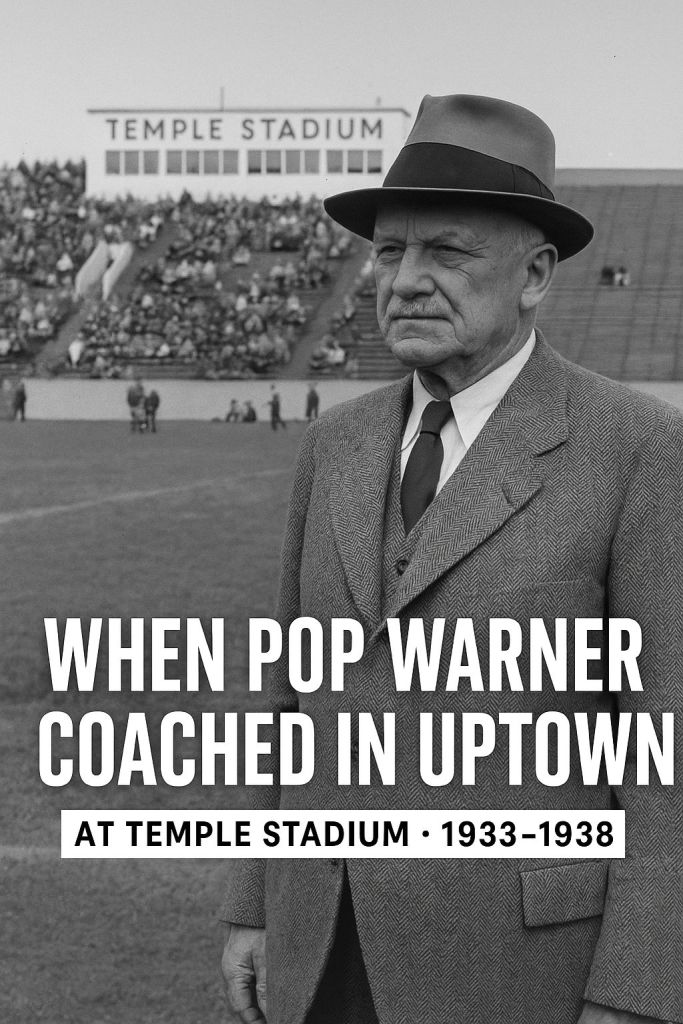
From 1933 to 1938, legendary coach Glenn “Pop” Warner brought the national spotlight to Temple University football — and he did it right here in Uptown Philadelphia, at the historic Temple Stadium near Cheltenham and Vernon Roads.
By the time Warner arrived at Temple, he was already a titan of the sport. He had coached Jim Thorpe at Carlisle Indian School, developed the single-wing formation, and led Pitt and Stanford to national prominence. At Temple Stadium, Warner turned practices into laboratories of innovation, drilling the double-wing and single-wing offenses, the three-point stance, and misdirection plays into his team’s routine. “You play the way you practice… practice right and you will react right,” he told his players, making it clear that discipline in training would translate into precision on game day.
Though Warner’s office remained on Temple’s North Broad campus, his day-to-day coaching took place Uptown at Temple Stadium, which had opened in 1928 with seating for over 20,000. The stadium became the site of intense practices and the launchpad for Temple’s first Sugar Bowl appearance in 1935. The local press marveled at the transformation, reporting that “Temple’s Football Stock Booms Under the Coaching of Warner; Stalwart Line and Speedy, Powerful Backfield Quick to Grasp Details of Famous Mentor’s System.”
Among Warner’s most celebrated players was Dave “Dynamite” Smukler. Warner believed Smukler “may become the greatest fullback I have ever seen… greater than Nevers or Thorpe,” a prediction that reflected the coach’s eye for talent. Smukler’s performance in the inaugural Sugar Bowl validated that praise, as he became one of the program’s enduring legends.
Warner’s influence at Temple went far beyond wins and formations. He elevated the program’s national reputation, established a disciplined recruiting system, and helped lay the foundation for youth football leagues like Pop Warner Little Scholars, which would later have ties to Philadelphia.
Though Temple Stadium was demolished in the 1990s, the spirit of what Warner built there still lingers in Uptown. His innovations helped shape the modern game, and his tenure marked Northwest Philadelphia as a true center of football excellence and pride.
 Uptown Standard