By James Williams
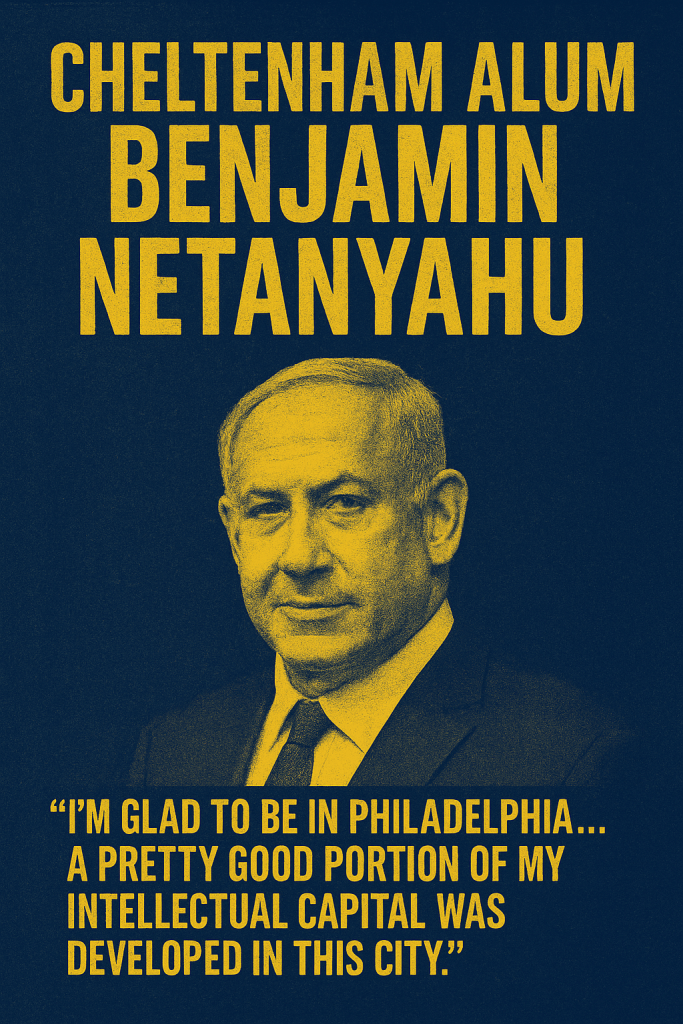
Before becoming Israel’s longest-serving prime minister, Benjamin “Bibi” Netanyahu was a teenager growing up in Wyncote, Pennsylvania. From 1963 to 1967, he attended Cheltenham High School, just outside the city limits of Philadelphia.
“I’m glad to be in Philadelphia… A pretty good portion of my intellectual capital was developed in this city,” Netanyahu told graduates during a speech at the University of Pennsylvania in 1999.
Known at the time as Ben Nitay, Netanyahu excelled at Cheltenham. He graduated fourth in his class, played left wing on the soccer team, and participated in debate, chess, and science seminars.
“He played left wing on the soccer team and was a tough competitor,” recalled classmate Chuck Langerman. “He showed anger when he wasn’t playing well or the team wasn’t. You could tell he was intense—even then.”
“Bibi was the only political conservative playing the most liberal sport in school—soccer,” Langerman added. “That was the exact opposite of his political views.”
Another classmate, Deborah Lefco, remembered him as “completely counter-counterculture” during an era of protest and student activism. “He was the lone voice in support of the conservative line,” she said.
Netanyahu’s worldview was shaped not just in school, but at home. His father, Benzion Netanyahu, was a Zionist historian teaching at Dropsie College in Philadelphia. He preached that Jewish survival depended on strength, vigilance, and national identity—not compromise.
While Bibi studied in the calm of Montgomery County, Philadelphia was erupting. Race riots, civil rights marches, and police brutality dominated headlines. In 1967, the same year Netanyahu left school, Frank Rizzo became police commissioner, ushering in an era of aggressive policing and political polarization.
“I saw what happens when society loses its will to defend itself,” Netanyahu would later say. “Democracies can fall under the sway of slogans and illusions.”
As the Six-Day War erupted in June 1967, Netanyahu left Cheltenham early—skipping graduation to enlist in the Israeli army. While American youth debated Vietnam, Netanyahu joined Israel’s elite commando unit, Sayeret Matkal, and went to war.
Though many compare Netanyahu’s toughness to that of Donald Trump, their backgrounds diverge.
Trump, raised in Queens and steeped in branding, represents the media-fueled swagger of the Rizzo era. Netanyahu, forged by real war and deep ideology, represents its steel spine.
“He saw the world differently from the rest of us,” said classmate Stretton. “More intense. More real.”
To many locals, Netanyahu’s connection to Cheltenham is more than a trivia fact—it’s a reminder of how global history intersects with neighborhood life.
> “As someone who grew up in Uptown but went to Bishop McDevitt,” one Philadelphia resident noted, “it’s amazing to think he shopped at the same stores as my coaches and classmates.”
Today, Cheltenham High can claim one of the most consequential—and controversial—leaders of modern times as an alum. His story is part of the Philadelphia region’s history, rooted in a moment where suburban quiet met global consequence.
 Uptown Standard