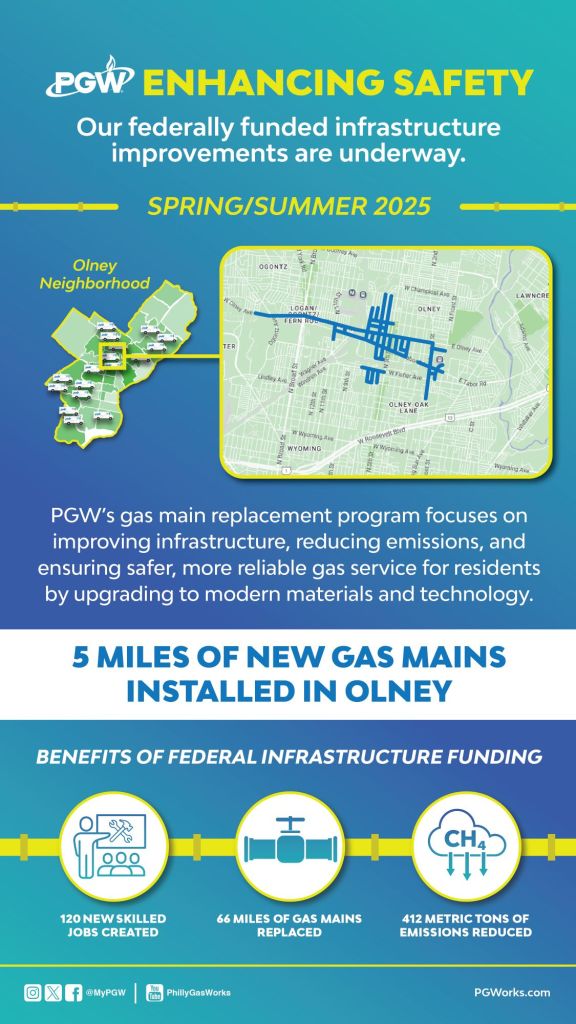
PGW is turning federal dollars into real change across Philadelphia, starting with a major infrastructure upgrade in the Olney section this month and continuing its push toward a cleaner, more sustainable energy future.
Backed by a $125 million grant from the federal Pipeline and Hazardous Materials Safety Administration (PHMSA)—secured through the Bipartisan Infrastructure Law—PGW is replacing 66 miles of aging cast iron gas mains across the city. The Olney project is the latest step in this historic overhaul. In addition to improving safety and reliability, this work is creating 120 new skilled jobs for local workers and dramatically reducing harmful methane emissions.
These aren’t just temporary jobs. Replacing aging gas mains requires union laborers, pipefitters, equipment operators, and engineers—many of whom will be trained through apprenticeships and placed into long-term careers with living wages. In addition, PGW’s contracting process opens the door for local and minority-owned businesses to bid on support services—whether that’s paving, equipment rental, or environmental oversight—keeping more of the investment in Philadelphia’s economy. The ripple effect supports even more local employment, as wages spent by workers flow into nearby stores, restaurants, and services.
The environmental impact is just as significant. PGW projects a reduction of 412 metric tons of methane emissions as a result of the upgrades. That effort is a key component of PGW’s broader plan to reduce methane emissions by 80% by 2050. Replacing the old pipes with corrosion-resistant materials stops methane from leaking into the atmosphere—one of the most effective steps a gas utility can take to reduce its environmental footprint.
In a newly released Greenhouse Gas Emissions Reduction Report, PGW shared that it had removed 10,000 metric tons of carbon dioxide equivalent (CO2e) from the atmosphere in 2024—exceeding its forecasted reduction target. That reduction is equivalent to taking more than 2,000 cars off the road for an entire year.
PGW is also signaling a clear shift toward clean energy innovation. In 2025, the company ramped up efforts in its EnergySense portfolio—a collection of customer-focused energy efficiency programs offering financial incentives for upgrades. PGW is also partnering with the School District of Philadelphia to explore geothermal energy through a new site survey and feasibility study. These efforts reflect PGW’s intention to diversify and modernize energy delivery in the decades ahead—and they create a pathway for future green jobs in fields like energy auditing, HVAC retrofitting, and environmental engineering.
With infrastructure upgrades now visible on the ground and emissions reductions setting new records, PGW is moving toward a future where public health, job creation, and environmental responsibility align. The transformation is underway—and it’s happening block by block, pipe by pipe.
The Town Crier, is a Rapid Response news blog that is written by James Williams and created in collaboration with ChatGPT. For research assistance and content editing. The image of the Town Crier was created by ChatGPT.
 Uptown Standard