By James Williams, Editor-in-Chief
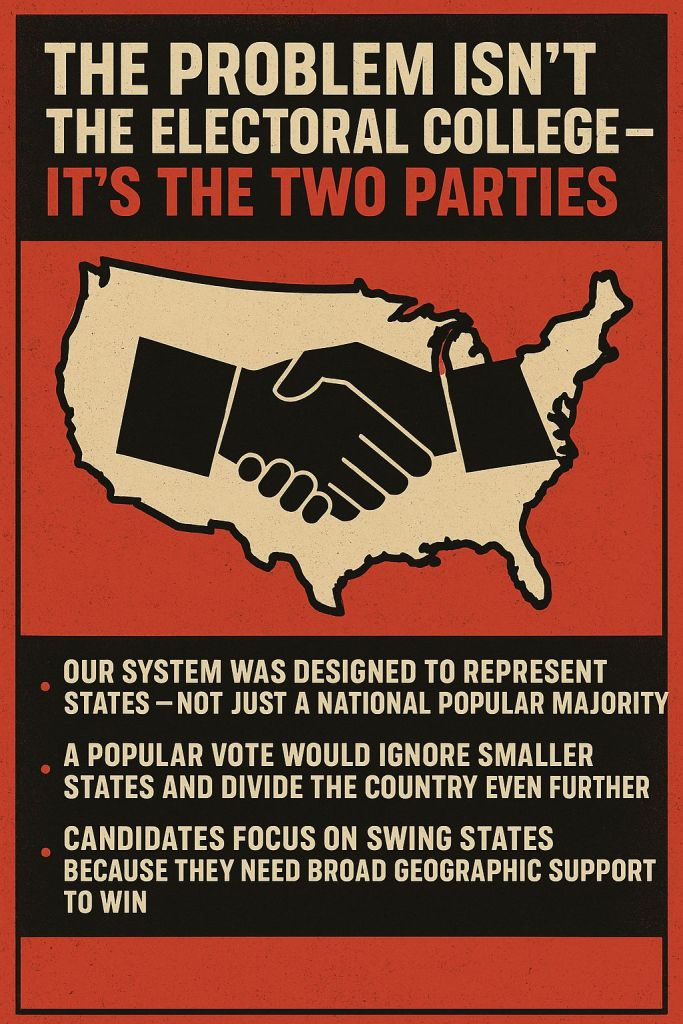
People keep saying the Electoral College is the problem, but let’s be real — the real problem is the two-party system. We don’t have an Electoral College issue in America. We have a Democrat and Republican issue — and a political culture that’s become hostile to nuance, hostile to federalism, and completely detached from what the Founding Fathers actually intended.
This country was never meant to be a pure democracy. The Founders feared the dangers of majority rule unchecked by institutional safeguards, which is why they built a hybrid government: a constitutional republic with representative democracy at its core. They were trying to protect minority voices, not just create a system where 51% of the people could tell the other 49% what to do.
They created checks and balances — like the Electoral College, the Senate with equal representation regardless of population, the lifetime-appointed judiciary, and the Bill of Rights — to keep the majority from overrunning the minority. James Madison spelled it out clearly in Federalist No. 10: factions are dangerous, and the best way to manage them is through a large republic where no one interest can dominate unchecked.
Our system was never designed for just two parties. It was constructed to unite a collection of sovereign states into one nation while preserving each state’s unique voice. The Electoral College is not some outdated relic; it’s a cornerstone of that compromise — one that keeps the interests of smaller states from being trampled by the sheer population power of the coasts.
Eliminating the Electoral College wouldn’t fix democracy; it could fracture the country even further. Why would less-populated states want to remain in a union where they have no meaningful voice? Under a pure national popular vote, they’d be politically irrelevant.
Take Wyoming, for example. With roughly 580,000 residents and 3 electoral votes, each vote represents about 193,000 people. Meanwhile, California has around 39 million people and 54 votes — meaning each of its electoral votes represents over 722,000 people. That’s nearly a 4-to-1 ratio of power in favor of smaller states. Critics call it unfair — but that’s the point. The system intentionally gives smaller states more leverage to preserve the union.
If we remove the Electoral College, we risk something far more serious than political dissatisfaction — we risk national fracture. Call it what you want: disillusionment, secession, a modern civil war. But it would be real. A country without representative federalism isn’t a republic. It’s majoritarian rule. And that’s not what the founders envisioned.
Even President Obama, in his memoirs, referred to large parts of the country as “flyover states” — ignored in national discourse unless there’s an election. And even then, the attention is laser-focused. In 2020, presidential campaigns spent more than $883 million in just six battleground states: Pennsylvania, Michigan, Wisconsin, Arizona, Georgia, and North Carolina. That’s not a national campaign. That’s marketing warfare in a handful of ZIP codes.
Still, the Electoral College at least forces candidates to build coalitions across diverse geographies. It makes states — not just voters — matter. And while swing states currently get the most attention, they rotate over time based on demographic and political shifts. That’s not a flaw. That’s how coalitions evolve.
Let’s not forget: five presidents have won the presidency without winning the popular vote — most recently George W. Bush in 2000 and Donald Trump in 2016. But that’s not evidence of a broken system. It’s evidence of a federal one — one where winning requires broad, distributed support across the country, not just urban population centers.
The real problem is that our two-party system is so rigid that it locks us into a zero-sum game every four years. Red vs. blue. Rural vs. urban. Coast vs. heartland. If we want to fix the system, we should be talking about breaking up the parties — not the Constitution.
This isn’t just about politics. It’s about national unity. Take away the states’ voice, and you take away the glue that holds this republic together.
less-populated states want to remain in a union where they have no meaningful voice? Under a pure national popular vote, they’d be politically irrelevant.
Take Wyoming, for example. With roughly 580,000 residents and 3 electoral votes, each vote represents about 193,000 people. Meanwhile, California has around 39 million people and 54 votes — meaning each of its electoral votes represents over 722,000 people. That’s nearly a 4-to-1 ratio of power in favor of smaller states. Critics call it unfair — but that’s the point. The system intentionally gives smaller states more leverage to preserve the union.
If we remove the Electoral College, we risk something far more serious than political dissatisfaction — we risk national fracture. Call it what you want: disillusionment, secession, a modern civil war. But it would be real. A country without representative federalism isn’t a republic. It’s majoritarian rule. And that’s not what the founders envisioned.
Even President Obama, in his memoirs, referred to large parts of the country as “flyover states” — ignored in national discourse unless there’s an election. And even then, the attention is laser-focused. In 2020, presidential campaigns spent more than $883 million in just six battleground states: Pennsylvania, Michigan, Wisconsin, Arizona, Georgia, and North Carolina. That’s not a national campaign. That’s marketing warfare in a handful of ZIP codes.
Still, the Electoral College at least forces candidates to build coalitions across diverse geographies. It makes states — not just voters — matter. And while swing states currently get the most attention, they rotate over time based on demographic and political shifts. That’s not a flaw. That’s how coalitions evolve.
Let’s not forget: five presidents have won the presidency without winning the popular vote — most recently George W. Bush in 2000 and Donald Trump in 2016. But that’s not evidence of a broken system. It’s evidence of a federal one — one where winning requires broad, distributed support across the country, not just urban population centers.
The real problem is that our two-party system is so rigid that it locks us into a zero-sum game every four years. Red vs. blue. Rural vs. urban. Coast vs. heartland. If we want to fix the system, we should be talking about breaking up the parties — not the Constitution.
This isn’t just about politics. It’s about national unity. Take away the states’ voice, and you take away the glue that holds this republic together.
 Uptown Standard