By James Williams, Editor-in-Chief
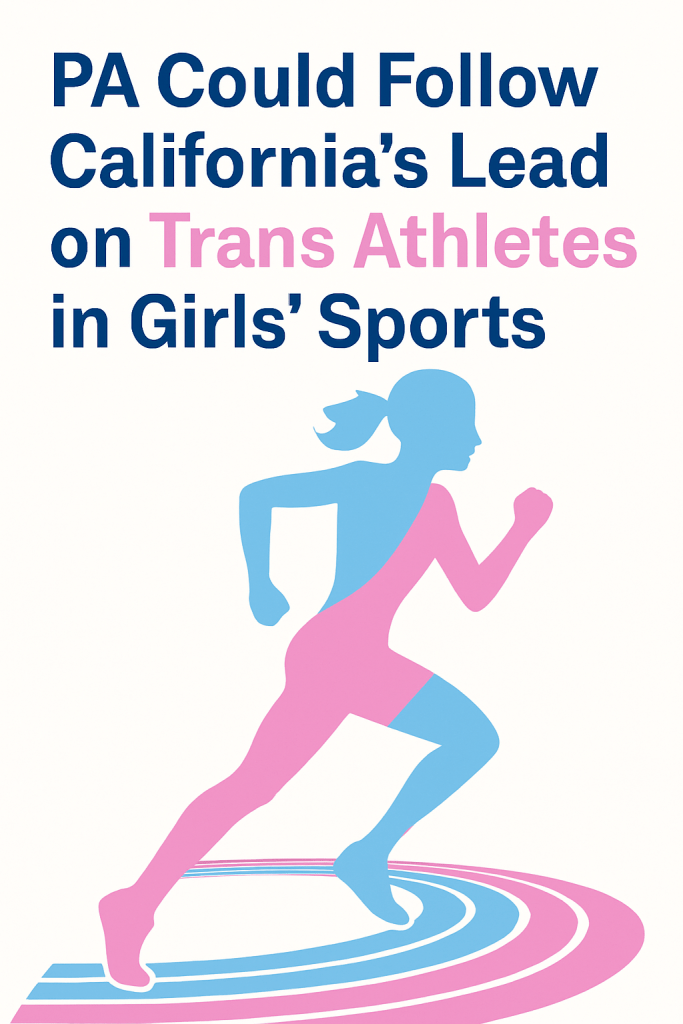
As the debate over transgender athletes intensifies nationwide, Pennsylvania and California have become case studies in how differently states can approach the issue. One restricts access, and the other expands it. One complies with political directives, and the other creates space for compromise. The question for Pennsylvania is simple: can we do better?
The case of Plymouth Whitemarsh senior Luce Allen—a transgender girl who finished 12th in the 200 meters at the PIAA District 1 championships—put the state’s policy squarely in the spotlight. Allen’s time of 25.89 seconds wasn’t enough to qualify for the state meet, but the controversy surrounding her participation underscores just how contested this issue has become.
Earlier this year, the Pennsylvania Interscholastic Athletic Association (PIAA) revised its policy on transgender athletes, a change widely seen as a quiet ban. In response to a 2025 executive order from former President Donald Trump that seeks to prohibit transgender girls and women from competing in female sports, the PIAA removed its existing “Transgender Policy” from its manual. The new policy now defers to school principals to determine a student’s “sex” when “questioned or uncertain” and requires schools to consult with legal counsel to ensure compliance with the executive order.
The language is vague, but the intent is clear: limit participation. While the policy stops short of an outright ban, it sets up enough legal red tape to make it extremely difficult for transgender athletes to compete—unless, as in Allen’s case, a federal court intervenes. A March ruling from U.S. District Judge Wendy Beetlestone denied a temporary restraining order that would have barred Allen from participating. The court’s decision allowed her to run, but only after legal wrangling.
Compare that to California.
When transgender athlete AB Hernandez qualified for the state track championships in the triple jump, long jump, and high jump, the California Interscholastic Federation (CIF) didn’t ban her. They didn’t hide behind legal ambiguity. Instead, they created a compromise.
CIF implemented a temporary rule that allowed one additional “biological female” to compete in each event Hernandez entered. If Hernandez medaled, the podium placements for cisgender girls would still be preserved. In other words, California added space instead of drawing lines. Hernandez competed. Other girls weren’t pushed out. The result? A shared podium, a fair meet, and a rare example of policy that put athletes first.
The best thing about California’s policy is that it allows both the transgender athlete and the cisgender female athlete to earn the same amount of points for their teams. No one is replaced. No one is erased. Everyone competes.
This prevents the kind of outcome that unfolded in the 2024 Maine Indoor Girls State Track & Field Championships, where Greely High School edged out Freeport by a single point—72 to 71—triggering national outrage. The deciding factor? Katie Spencer, a trans-identifying male athlete, won the girls’ pole vault title with a jump of 10 feet, 6 inches—more than six inches higher than any other competitor. That victory secured the championship for Greely, and sparked widespread debate about fairness and competitive equity, with many critics questioning Spencer’s participation in the girls’ division.
California’s policy seeks to avoid that scenario entirely. It ensures that both trans and cisgender athletes can contribute to their teams’ success without displacing one another or fueling unnecessary conflict.
California’s approach isn’t perfect. The definitions around “biological female” remain unclear. The policy is temporary. But it’s a serious, good-faith effort to find middle ground. It recognizes the legitimate concerns of fairness in competition while refusing to erase the identities or ambitions of transgender athletes.
Pennsylvania should follow suit. Rather than enforce vague rules that lead to courtrooms and controversy, the PIAA could allow expanded fields in objectively measured events like track and swimming. It could develop policies that respect both gender identity and competitive equity. Most importantly, it could treat these athletes—cisgender and transgender alike—not as legal liabilities, but as students who deserve the chance to compete.
This isn’t about scoring political points. It’s about creating a path forward that doesn’t sacrifice fairness for inclusion—or vice versa.
California showed it can be done. Now Pennsylvania needs to decide if it has the courage to try.
 Uptown Standard