By James Williams, Editor-in-Chief
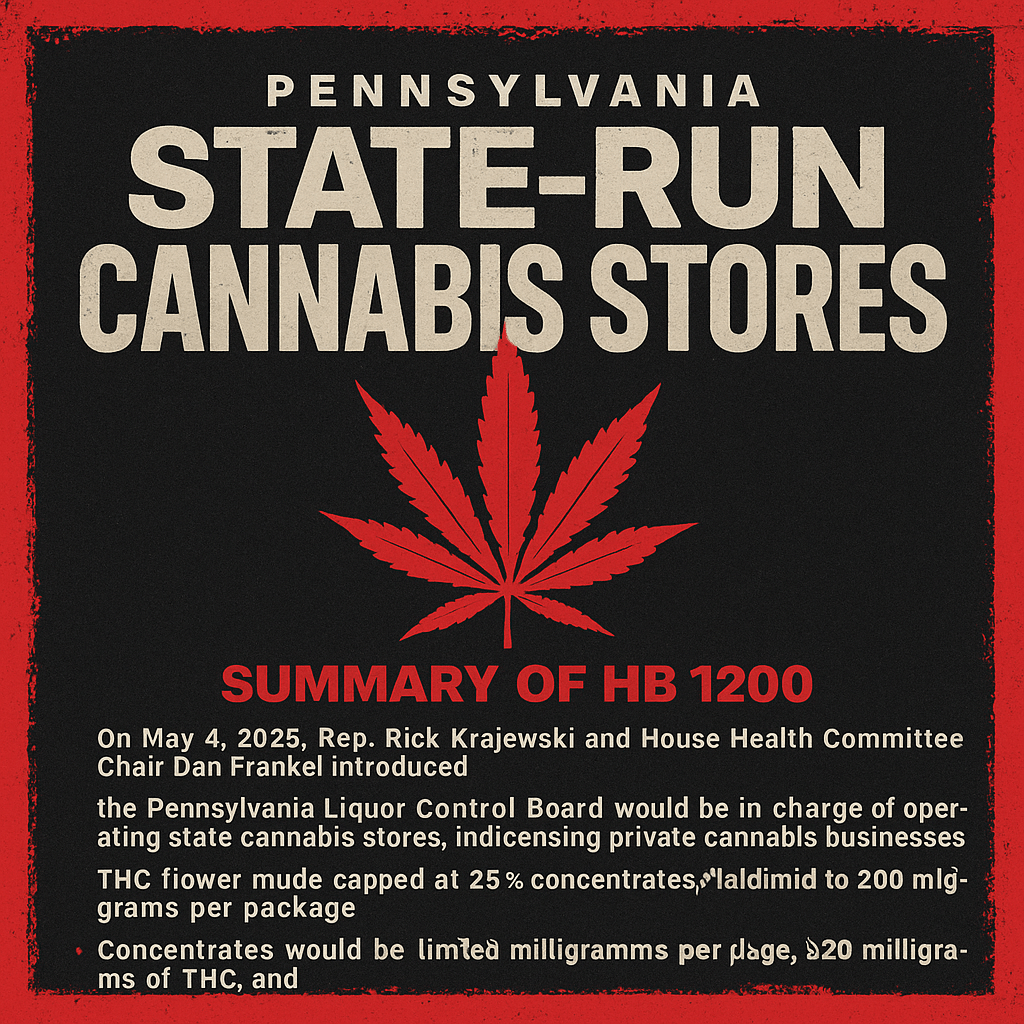
On May 4, 2025, State Rep. Rick Krajewski and House Health Committee Chair Dan Frankel introduced House Bill 1200, known as the Cannabis Health and Safety Act—a sweeping proposal to legalize and regulate adult-use cannabis in Pennsylvania. The bill would not only legalize possession and personal cultivation but also empower the Pennsylvania Liquor Control Board (PLCB) to oversee a comprehensive cannabis marketplace, including the operation of state-run cannabis retail stores.
Decriminalization and Possession Limits
Under HB 1200, adult possession of cannabis would initially be decriminalized. Until commercial sales begin, adults found with up to 30 grams of cannabis or 8 grams of hashish would face a summary offense with a maximum $250 fine. Once the PLCB issues a notice that sales will begin in 90 days, adults over 21 could legally possess up to 1.5 ounces of flower, 5 grams of concentrates, or up to 500 milligrams of cannabis-infused products.
Home cultivation would also be permitted, allowing individuals to apply for an annual $100 permit to grow two mature and two immature plants per household. Possession above the legal limits would carry scaled penalties—from $250 to $500 fines—until quantities exceed four and a half ounces, which would then trigger misdemeanor charges.
State-Run Stores and Private Licensing
One of the most unique aspects of HB 1200 is that state-run cannabis stores would be established by the Liquor Control Board, either as stand-alone locations or co-located with existing state liquor stores. These stores would handle all retail sales and could lease shelf space or use dispensing fees to manage inventory from licensed private cultivators and processors.
The PLCB would also license private actors across the supply chain, including:
50 cultivators and 50 micro-cultivators
50 processors and 50 microprocessors
Up to 50 transporters
On-site consumption lounges (limited to municipalities that opt-in)
Product regulations would be strict. THC in flower would be capped at 25%, concentrates limited to 200 mg per package, and edibles restricted to 25 mg per package and 5 mg per serving. Packaging would need to be plain, child-resistant, and feature prominent health warnings. Advertising would be tightly regulated and prohibited near schools or locations where children congregate.
Social Equity and Community Reinvestment
HB 1200 centers social and economic equity through the creation of a dedicated Office within the PLCB. This office would oversee efforts to prioritize licenses for applicants from communities disproportionately harmed by cannabis criminalization. License fees for certified social equity applicants would be cut in half or waived entirely.
A Communities Reimagined and Reinvestment Fund would receive half of all state cannabis tax revenue to support grants for job training, housing, mental health, substance use treatment, and legal services in historically impacted communities. Other funding allocations include:
10% for substance use education and treatment
5% to the Cannabis Business Development Fund
2.5% to the PA Minority Business Development Authority
2% to cover expungement administration
The remainder to the General Fund
Expungement and Criminal Justice Reform
HB 1200 would automatically vacate and expunge all past cannabis convictions, streamlining the process through state courts and laboratories. Expungement would be mandatory, with timelines ranging from immediate to two years depending on case complexity. Minors in possession would no longer face incarceration but rather a graduated system of fines and diversion programs.
The bill also protects cannabis consumers from discrimination, barring penalties related to child custody, organ transplants, firearm ownership, and employment—unless workplace drug policies were clearly disclosed or federally mandated.
Oversight, Safety, and Taxation
The bill proposes a 12% excise tax on cannabis products sold at state stores, with municipalities allowed to impose up to an additional 3% tax on on-site consumption lounge sales. HB 1200 also mandates worker training, cannabis lab testing, and market analysis updates every three years.
To prevent corruption and ensure ethical operations, public officials and their families would be banned from investing in cannabis businesses for two years post-tenure, and multiple agencies would be required to adopt codes of conduct.
Timeline and Implementation
The Liquor Control Board would have 180 days to draft temporary regulations. Once finalized, it would issue a 90-day notice before initiating retail sales, which would only then trigger full legalization. If such notice is never issued, cannabis remains decriminalized but not legalized.
Final Thoughts
HB 1200 is perhaps the most ambitious cannabis bill in the nation, blending state control with private market dynamics, social equity, public health safeguards, and criminal justice reform. Whether the bill clears both chambers and survives potential federal conflicts remains uncertain—but its introduction marks a bold legislative step in Pennsylvania’s cannabis future.
The Town Crier, is a Rapid Response news blog that is written by James Williams and created in collaboration with ChatGPT. For research assistance and content editing. The image of the Town Crier was created by ChatGPT.
 Uptown Standard