By James Williams, Editor-in-Chief
State Rep. Chris Rabb and Rep. Heather Boyd have reintroduced House Bill 270, legislation that would enroll Pennsylvania in the National Popular Vote Interstate Compact—a coalition of states that pledge their electoral votes to the winner of the national popular vote, regardless of who wins within their own borders. Proponents say it would make every vote count equally. But behind the surface of fairness lies a deeper threat to the balance of American democracy—particularly for rural states and communities like many across Pennsylvania.
The United States has never been a pure democracy. It is a constitutional republic founded on a system of checks and balances, designed to protect both the majority and the minority. The Electoral College—established in 1787—was one of those mechanisms, created to ensure that all states, regardless of population size, have a voice in the selection of the nation’s leader. The Founding Fathers understood the dangers of concentrated power and designed the Electoral College to compel candidates to seek broad, nationwide support, not just popularity in densely populated areas.
By contrast, the National Popular Vote Compact would upend this principle. If enacted, it would effectively nullify the will of Pennsylvania voters if their choice differed from the national majority. With Pennsylvania’s 19 electoral votes at stake, the state could end up awarding its votes to a candidate who lost here but won in places like California or New York. That isn’t representation—it’s surrender.
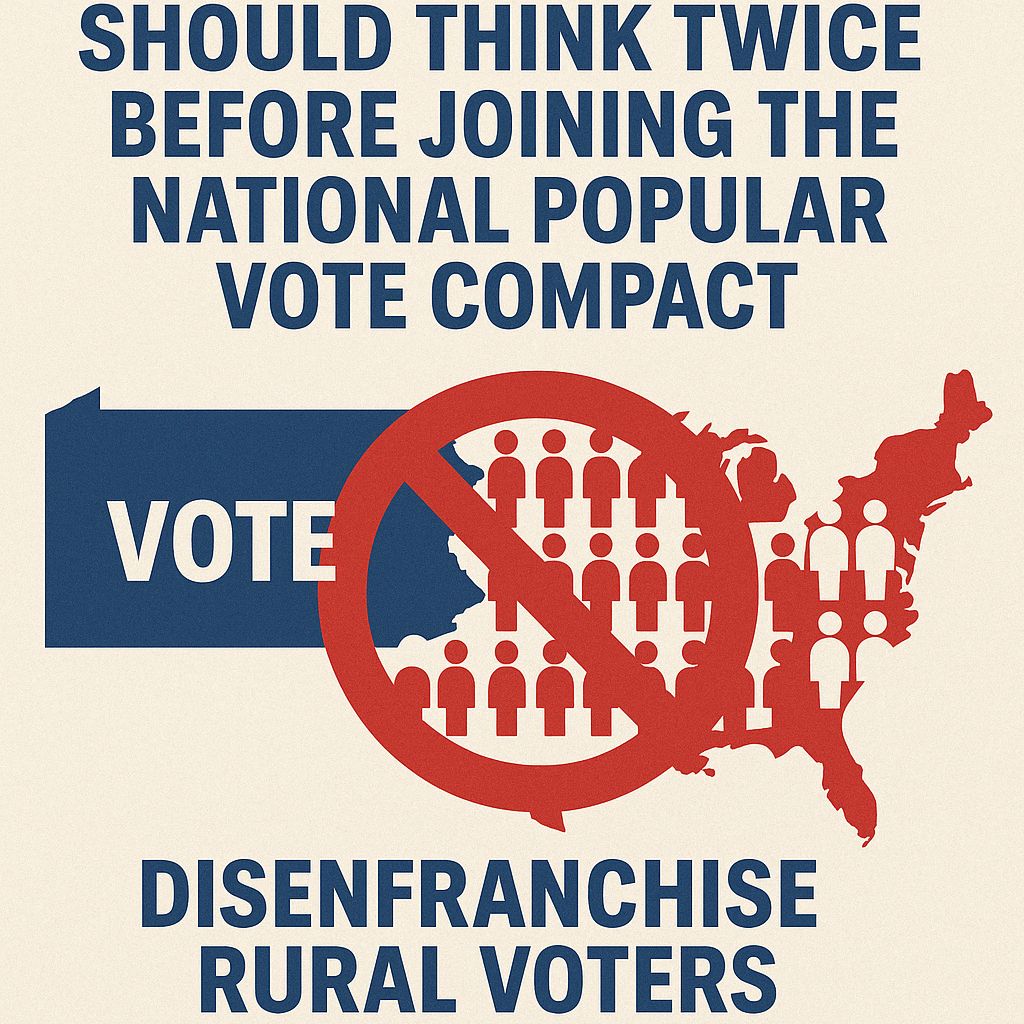
The effects of such a shift would be felt most harshly by rural communities. Under the current Electoral College system, presidential campaigns must build coalitions that include a wide variety of states—urban, suburban, and rural alike. But a popular vote system would incentivize candidates to focus exclusively on the biggest population centers. Cities like New York, Los Angeles, and Chicago could dominate campaign strategy, while rural and small-town voters in places like Central and Western Pennsylvania would be ignored. Their votes would still be counted, yes, but their concerns would no longer shape campaign platforms or policy agendas.
This is why critics argue that the National Popular Vote movement risks disenfranchising rural Americans. It doesn’t do so by taking away their right to vote—it does so by making their votes politically irrelevant. In a country where a small handful of cities could decide a national election, the voices of farmers, miners, small business owners, and working-class families outside the urban core would be muted.
Supporters of H.B. 270 claim it would make elections more democratic, pointing out that five presidents in U.S. history—including two in recent decades—won the presidency without winning the popular vote. But these outcomes are not flaws; they are features of a system designed to protect national unity and ensure presidents represent the interests of a diverse federation of states, not just the majority in a few urban centers.
Moreover, the National Popular Vote Compact itself is legally dubious. It seeks to alter the balance of presidential elections without a constitutional amendment—a move that could be challenged in court and create chaos in future elections. Instead of strengthening the electoral system, it introduces uncertainty and undermines the constitutional foundation of presidential elections.
Pennsylvania, as one of the nation’s most diverse and electorally influential states, has long played a pivotal role in determining the presidency. That influence comes not just from its population, but from its geographic and ideological diversity—a blend of rural, urban, and suburban voters that candidates must court and understand. Abandoning that role to align with national vote totals is not democratic progress; it’s political abdication.
The Electoral College isn’t perfect, but it has served this country for over two centuries by compelling candidates to build consensus across regional, cultural, and economic lines. Rather than rush into a compact that sacrifices the political voice of rural Pennsylvanians, we should reaffirm the value of a system that protects all voices—especially those that are too often overlooked.
In a nation as large and varied as ours, fairness doesn’t come from counting votes alone. It comes from ensuring that every community matters—not just the most crowded ones. House Bill 270 would move Pennsylvania—and the country—in the wrong direction.
The Editor’s Desk is written by James Williams and created in collaboration with ChatGPT. For research assistance and content editing. The image of the Town Crier was created by ChatGPT
 Uptown Standard